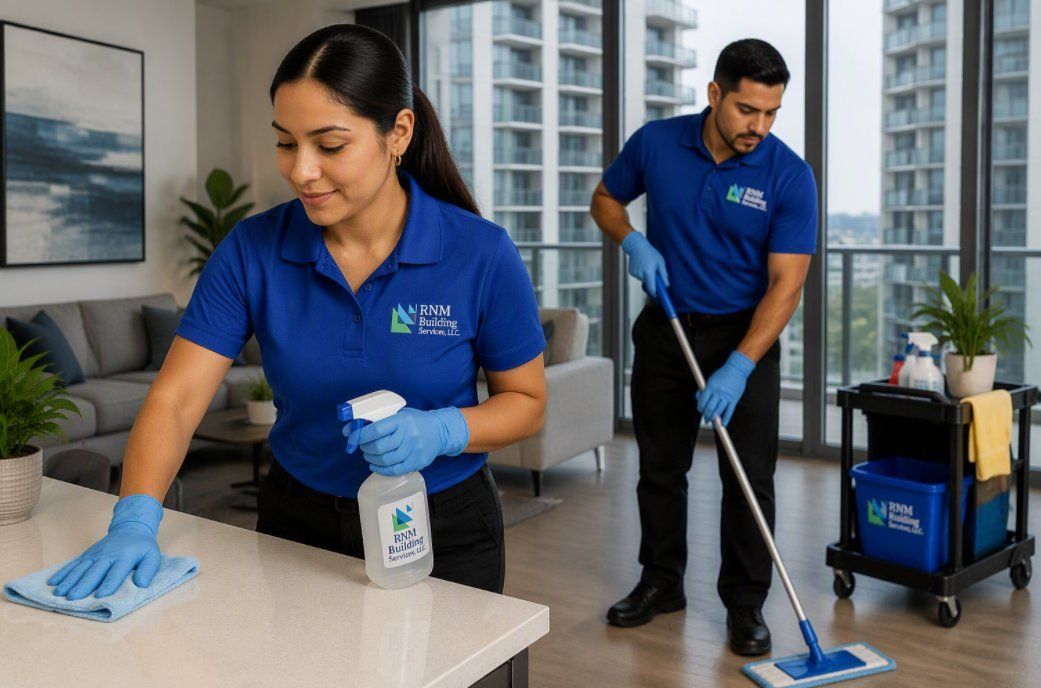
Condo cleaning contracts define how an association’s shared spaces are cleaned, inspected and maintained between scheduled visits. For HOA boards and property managers, a useful agreement connects each area to specific tasks, a service schedule and someone accountable for correcting missed work.
- Condo cleaning contracts should name covered areas, tasks, frequency, exclusions and inspection responsibility.
- Separate recurring common-area cleaning from carpet extraction, floor restoration and event cleanups.
- Route resident concerns through one association contact so instructions stay consistent.
- RNM Building Services offers condo cleaning services with written scopes and owner-led inspections in Montgomery County.
Why the contract matters to your board
Residents see the lobby, entry glass and hallway carpet every day. Your agreement needs to explain what happens in those spaces, not simply promise a clean building. RNM’s condo and HOA common-area cleaning services identify the areas to discuss during a site walkthrough.
A board in Rockville, Bethesda or Silver Spring also needs continuity when its members change. The accepted scope should let a new property manager understand the job without reconstructing conversations from old emails.
Treat the cleaning scope as an inspection document, not just a purchasing document. This 2026 guide explains how to prepare that scope, compare proposals and manage the relationship. It is an operational checklist, not legal advice about a particular association or contract.
Build the agreement around your actual property
1. Map the common areas before requesting quotes
Start with your building plan or a simple room list. Walk the route residents use from the entrance to their units, then add shared facilities that are less visible: laundry rooms, trash rooms, stair landings and amenity storage areas.
Record who is responsible for each space. Cleaning a common hallway does not automatically include entering a private unit, clearing a resident’s belongings or handling work assigned to another contractor.
Mark optional areas separately. A community with a clubhouse needs different coverage from a building with enclosed corridors and elevators. Do not copy another association’s contract without checking those differences.
Prepare a walkthrough brief with:
- Building entrances, lobbies and mail areas.
- Hallways, stairs, landings and elevator interiors.
- Shared restrooms, laundry rooms and waste rooms.
- Clubhouses, fitness rooms and other amenity spaces.
- Floor materials and existing condition concerns.
- Excluded spaces and responsibilities assigned elsewhere.
2. Turn each area into a clear task list
An area name is not a cleaning instruction. For an entrance, distinguish door glass, handles, mats, floor surfaces and nearby waste containers. For carpeted stairs, clarify routine vacuuming and spot attention separately from extraction.
Use language that a supervisor can inspect. Instead of asking for a lobby that always looks perfect, identify the surfaces and tasks covered during scheduled service. Discuss existing stains or damaged finishes before making them part of an acceptance checklist.
Include a correction path for uncertainty. If a crew encounters an unfamiliar finish or a blocked area, specify whom to contact rather than expecting the cleaner to improvise.
For each covered space, document:
- Surfaces and fixtures included in routine cleaning.
- Tasks required on each scheduled visit.
- Tasks performed less frequently.
- Access limitations and items the crew must not move.
- Who supplies liners, soap and paper products.
- Existing damage or conditions outside cleaning scope.
3. Match visits to traffic and building use
Choose a schedule after a walkthrough, not from a universal formula. Resident traffic, delivery activity, amenity bookings and floor materials all belong in the discussion. A busy entrance and a seldom-used meeting room need separate consideration.
Your 2026 service calendar should identify actual service days and how closures or restricted access affect the work. Do not assume a missed-access visit will automatically be repeated; ask what the agreement says.
Discuss seasonal adjustments before they become urgent. Wet-weather entry soil, scheduled moves and clubhouse openings are planning topics, not reasons to leave routine coverage undefined.
Confirm these scheduling details:
- Normal service days and permitted working hours.
- Areas that need attention on every visit.
- Tasks rotated across the schedule.
- Holiday and building-closure arrangements.
- Rules for rescheduling inaccessible work.
- Authorization for extra visits or event cleanups.
4. Separate recurring cleaning from project work
Routine vacuuming and carpet extraction are different tasks. The same distinction applies to routine hard-floor cleaning and stripping or refinishing. A broad phrase such as floor care does not establish which work is included.
Ask bidders to identify periodic projects individually, including preparation and how residents will be informed. For example, an extraction project needs coordination around access and returning the space to use; agree on those arrangements with the provider.
RNM Building Services lists scheduled carpet extraction and hard-floor care among the services discussed for condominium properties. Confirm the exact inclusion and frequency in your proposal rather than treating the website description as a substitute for the agreement.
Keep separate lines for:
- Routine vacuuming and hard-floor cleaning.
- Carpet extraction and agreed spot-treatment work.
- Hard-floor restoration or finish maintenance.
- Move-related and post-project cleanups.
- Seasonal amenity openings and detailed cleaning.
- Exterior work included through a separate scope.
5. Assign inspections and resident reporting
Name the person who inspects the work and the association representative who receives findings. A complaint inbox is useful, but it is not the same thing as checking completed tasks against the scope.
Give residents a consistent reporting route. Ask them to identify the location, condition and time observed, then have the property manager or designated board contact coordinate with the provider. Avoid having several residents issue competing instructions directly to the crew.
RNM Building Services describes owner-led inspections and reporting to the board, property manager or both. Ask how that arrangement will work at your address, including the contact to use when the regular representative is unavailable.
Write down:
- Who performs inspections and what they check.
- Who can request a correction or change the scope.
- How a resident concern reaches the contractor.
- How the contractor confirms corrective action.
- How repeated concerns are reviewed.
- How observations are distinguished from newly occurring messes.
6. Review the agreement and plan the handover
Read the proposed contract alongside its cleaning schedule. Check start dates, renewal wording, notice requirements, exclusions and the process for approving additional work. Request written clarification where those documents conflict.
Ask the association’s appropriate adviser to review legal or insurance questions. This guide does not establish which terms your governing documents require or who has signing authority for your association.
For a 2026 handover, document the starting condition with the selected provider. An old stain, damaged threshold or broken dispenser should not become a dispute about whether the first cleaning visit was completed.
Finish the handover with:
- The accepted scope and service calendar.
- Authorized association and contractor contacts.
- Approved access and lock-up instructions.
- Supply-storage and equipment arrangements.
- Starting-condition notes for problem areas.
- A process for approving changes and extra work.
Compare service arrangements without comparing different jobs
A recurring contract, a project-only booking and a combined plan solve different problems. Choose the arrangement that matches the property’s needs, then compare bids for that same arrangement. None is automatically the right answer for every association.
| Arrangement | Best for | Practical advantage | Limitation to address |
|---|---|---|---|
| Recurring common-area cleaning | Associations needing a predictable cleaning schedule | Gives routine tasks defined ownership | Periodic restoration is not automatically included |
| Project-only service | A defined extraction, deep-cleaning or seasonal project | Makes the project boundary easier to specify | Does not provide ongoing routine cleaning |
| Recurring service with scheduled projects | Buildings needing routine care plus periodic specialist work | Coordinates routine and project planning | Each project still needs explicit inclusions and authorization |
When reviewing 2026 bids, compare scope first and quoted totals second. A proposal that excludes amenity rooms or consumables is not directly comparable with one that includes them. Ask each provider to revise unclear lines before the board makes its decision.
Use the same walkthrough brief for every bidder. If the board later adds a laundry room or changes the service days, distribute that update consistently so the final proposals describe the same job.
What changes a condo or HOA cleaning quote?
A customized quote reflects the property and the agreed work. Unit count provides context, but it does not describe how many shared surfaces, stairs or amenity rooms the crew must clean.
Ask each company to explain its assumptions about:
- Area and layout: covered buildings, shared rooms, stairs and travel between spaces.
- Service frequency: visit days and tasks required on those visits.
- Traffic: resident activity, deliveries, moves and amenity use.
- Materials and condition: floor surfaces, interior glass and existing problem areas.
- Supplies and access: consumable responsibilities, storage and working restrictions.
- Project work: extraction, restoration and additional cleanups outside routine visits.
Keep the decision quote-based. This 2026 guide does not provide a universal rate because a rate without a defined scope cannot tell your board what it is buying. Request an on-site assessment and a written proposal for the actual property.
Common mistakes boards can prevent
Approving a vague common-area description. A proposal that names the building but not its rooms leaves too much interpretation. Attach the covered-area list and confirm exclusions before accepting it.
Treating every resident request as a contract change. A reported spill and a request to add a new cleaning area are different instructions. Use the designated association contact to separate corrective work from additional service.
Relying on complaints as the inspection system. Complaints identify concerns, but they do not show whether every agreed task was completed. Require a named inspection responsibility and a way to follow up.
Leaving periodic work undefined. A routine cleaning schedule does not establish when carpet extraction or floor restoration will happen. List those projects explicitly, including how they are approved.
Ignoring the condition at takeover. Cleaning cannot be assumed to repair damaged materials. Record existing conditions during the handover so the board and provider share the same starting point.
Where RNM Building Services fits
RNM Building Services offers owner-inspected condo cleaning services for Montgomery County boards and property managers seeking recurring common-area care. Its service description includes lobbies, corridors, stairs, elevator interiors, shared restrooms and amenity spaces, with a written scope developed after a walkthrough.
The useful distinction is accountability: a consistent crew arrangement, ownership inspections and one direct contact. Confirm the inspection and communication details in your own agreement rather than relying on a general promise.
The boundary matters too. A common-area contract does not automatically cover private residences, every exterior surface or every specialist project. RNM Building Services provides a customized quote, so your board must agree on the actual tasks, schedule and exclusions before service begins.
FAQ
What should a condo cleaning contract include?
A condo cleaning contract should identify covered areas, cleaning tasks, frequency, supplies, exclusions and inspection responsibility. It should also explain access, corrective work and how the association approves additional service.
How often should condo common areas be cleaned?
Set the schedule after assessing traffic, building layout and use of shared facilities. Ask the provider to explain the recommended frequency for each area rather than applying one schedule to every room.
Does an HOA cleaning contract include individual homes?
Do not assume individual homes or units are included. Specify common-area boundaries and identify any separately authorized private-space work in writing.
Should carpet extraction be part of the contract?
Carpet extraction should be identified explicitly if your association wants it included. Routine vacuuming alone does not establish an extraction schedule or project allowance.
Who should handle resident cleaning complaints?
The property manager or designated board contact should coordinate resident concerns with the contractor. Provide the location, condition and time observed so the provider can distinguish missed work from a new incident.
Can RNM report to both the HOA board and property manager?
RNM Building Services states that it can report to the board, the property manager or both. Agree on the reporting arrangement and the person authorized to approve changes during the walkthrough.
What should a board check before renewing its cleaning agreement?
Compare the current scope with the property’s actual use, inspection findings and unresolved concerns. Review renewal and notice wording in the agreement and obtain appropriate advice where terms are unclear.
One last thing: keep an association copy of the working scope
Store the accepted scope, schedule and contact arrangements where the next board or property manager can find them. The contract should remain usable after the person who negotiated it leaves. Review changes in writing instead of relying on instructions passed between residents and cleaners.
For a Montgomery County property, request a walkthrough from RNM Building Services with your area list and existing concerns ready. The next step is a customized cleaning plan and quote—not an assumed package based on another building.