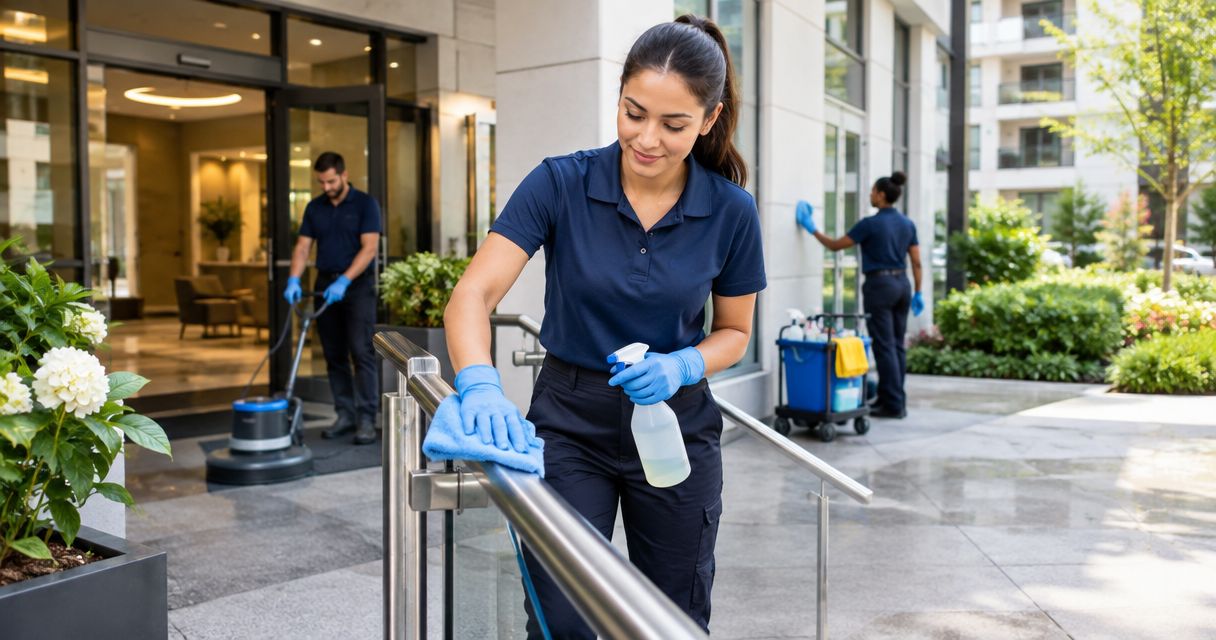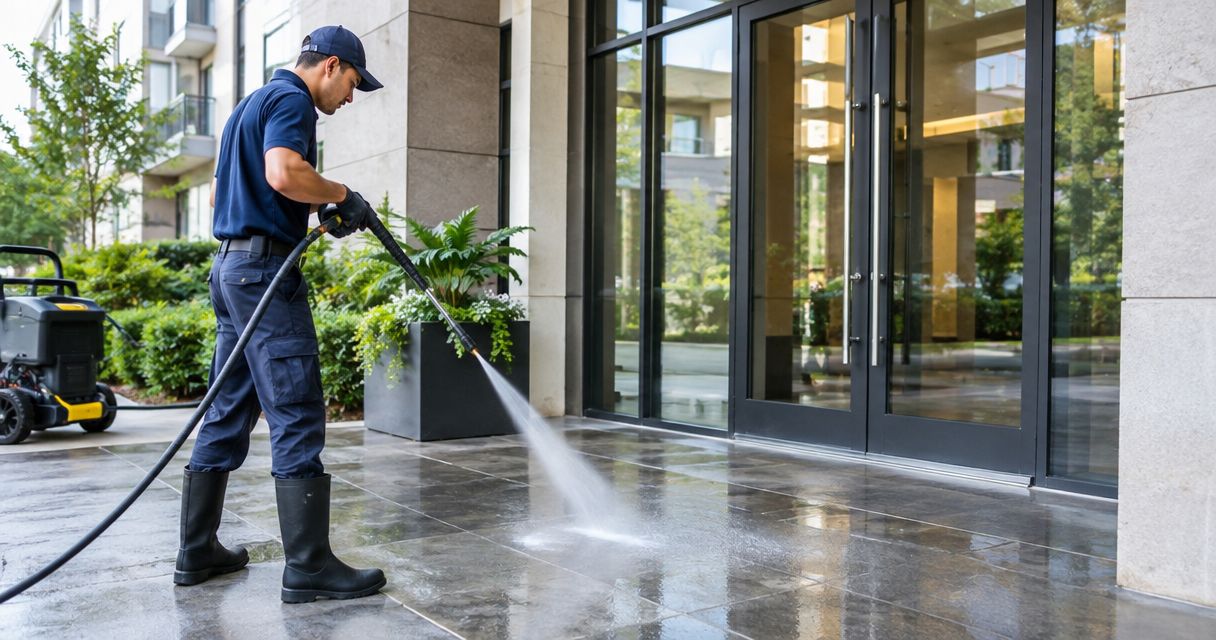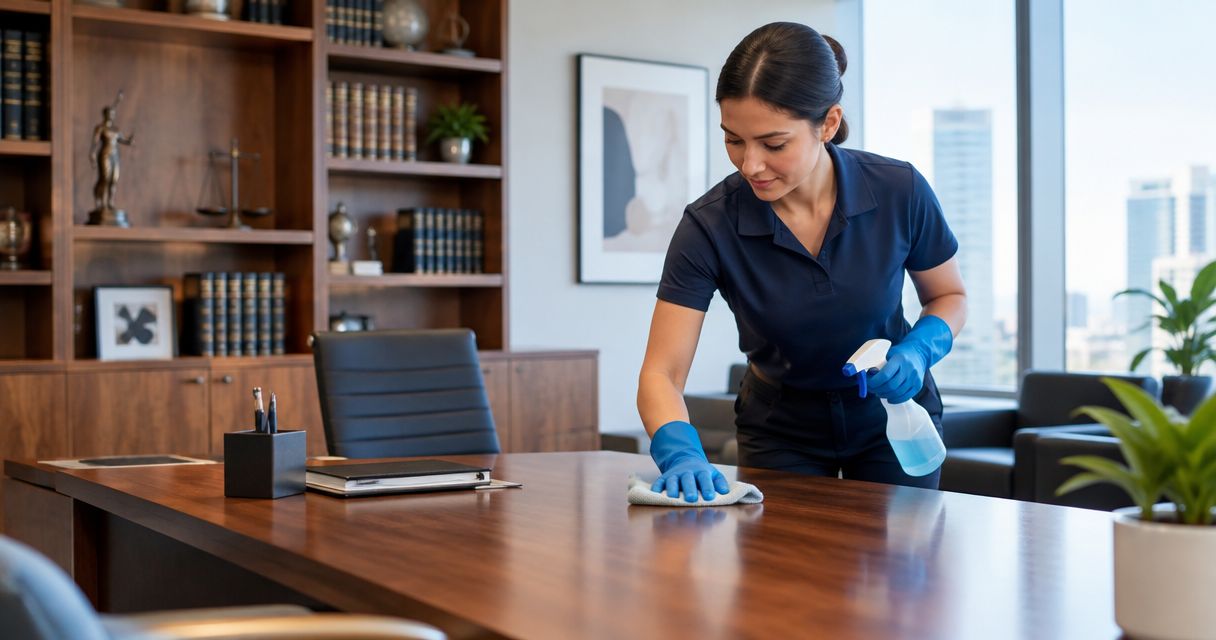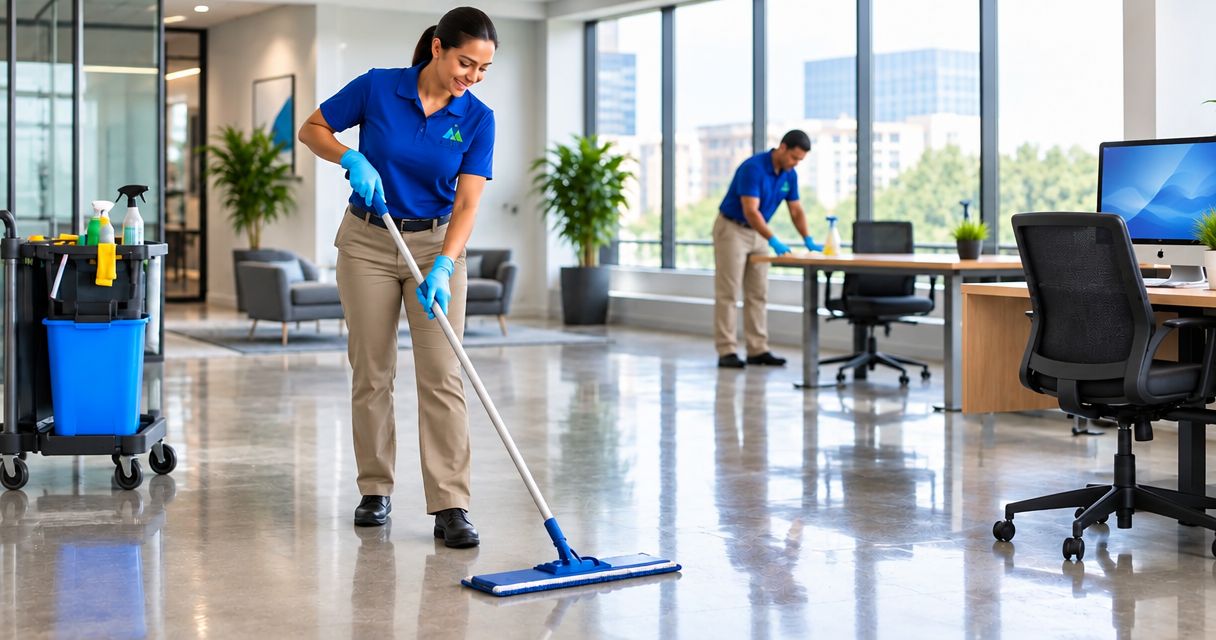
Best fit for offices, condominiums, HOAs, and managed properties: RNM Building Services. For commercial cleaning in Silver Spring, MD, confirm service coverage and property suitability before comparing the written scope for your 2026 agreement.
- For commercial cleaning in Silver Spring, MD, consider RNM Building Services for offices and managed properties.
- Choose recurring janitorial service for routine upkeep; separate specialty work from the regular cleaning checklist.
- Compare contractors against the same rooms, tasks, access rules, and inspection requirements.
- Select a commercial cleaning company only after the walkthrough and written responsibilities match your property.
Why the right cleaning company depends on your building
An office, condominium, and HOA common area do not need identical cleaning plans. Your contractor needs to understand which spaces are included, who uses them, and when work can happen without disrupting occupants.
For a 2026 shortlist, separate provider suitability from contract suitability. A company can serve your property type and still submit a proposal that leaves important responsibilities undefined. The best choice is the contractor whose written plan matches the actual building.
RNM Building Services is a commercial cleaning option for Montgomery County offices and managed properties. Its stated services include commercial cleaning, janitorial work, and building maintenance. Those are relevant starting points for Silver Spring property managers, not a substitute for confirming the exact assignment.
The comparison distinguishes a named provider from service-contract models. It does not claim verified rankings or review scores for other local companies.
What makes the best commercial cleaning company?
Use these criteria before reading a proposal. Each one should produce a concrete answer you can compare across candidates.
- Property fit: The contractor's proposed plan addresses your office, condominium, HOA, or managed property's actual spaces.
- Written scope: Tasks, rooms, exclusions, and frequencies appear in the agreement rather than remaining verbal promises.
- Access and scheduling: Arrival times, keys, alarms, restricted rooms, and occupant access have clear instructions.
- Quality control: You know who checks the work, records problems, and confirms corrections.
- Surface-specific methods: The proposal distinguishes routine upkeep from carpet treatment, floor restoration, and other specialty work.
- Accountability: One named contact receives service issues, and the contract explains who owns each responsibility.
Request 3 comparable proposals against the same checklist. This is a procurement recommendation, not a guarantee of quality; equivalent scopes support a fair comparison.
Commercial cleaning options at a glance
Only the first entry below names a specific company. The remaining entries are contracting approaches to consider when your building needs a narrower or different assignment.
| Ranked option | Best for | Standout fit | Key limitation |
|---|---|---|---|
| RNM Building Services | Offices, condominiums, HOAs, and managed properties seeking a locally relevant shortlist candidate | Stated commercial cleaning, janitorial, and building maintenance services throughout Montgomery County | The individual property's tasks, schedule, and reporting requirements still need agreement |
| Recurring janitorial contract | A property needing a defined routine cleaning schedule | Repeatable room-by-room responsibilities | Specialty treatments are not automatically included |
| Specialty cleaning assignment | A specific carpet, floor, or other surface-care project | A narrowly defined treatment and completion standard | Does not replace recurring cleaning |
| Maintenance-led contract | A property needing cleaning coordinated with building upkeep | Explicit division between cleaning and maintenance tasks | A broad maintenance description can leave cleaning responsibilities unclear |
1. RNM Building Services: best shortlist fit for managed properties
RNM Building Services provides commercial cleaning, janitorial, and building maintenance services for offices, condominiums, HOAs, and managed properties throughout Montgomery County, Maryland. That stated coverage makes it relevant to a Silver Spring search involving those property types.
Start the conversation with your building's actual requirements. An office manager should identify occupied work areas and access restrictions; a condominium or HOA manager should distinguish common areas from private spaces.
RNM Building Services pros:
- Its stated service area includes Montgomery County.
- Its stated customer types include offices, condominiums, HOAs, and managed properties.
- Its service description includes both cleaning and building maintenance.
RNM Building Services considerations:
- A broad service description does not define your site's cleaning checklist.
- Recurring tasks, specialty work, inspection arrangements, and access requirements need a written agreement.
Ask for a proposal that separates included work from optional assignments. For example, a request for carpet cleaning should identify the affected areas and requested method rather than rely on the general phrase “floor care.” Do not assume a particular treatment is included because a contractor offers commercial cleaning.
Best for: Property managers whose building type and location match the company's stated coverage.
Selection requirement: Confirm suitability during the walkthrough and in the written scope before awarding the work.
2. Recurring janitorial contract: best for routine upkeep
A recurring janitorial contract defines the cleaning tasks performed on an agreed schedule. Use this approach when your main problem is repeatable upkeep rather than an isolated restoration project.
Build the scope around observable tasks: empty designated waste containers, clean agreed restroom fixtures, address specified touchpoints, and clean identified floor areas. Then assign frequencies based on how each area is used. A meeting room and a busy entrance should not inherit the same schedule without a reason.
Recurring janitorial contract pros:
- Gives routine work a documented schedule.
- Makes room-by-room inspections easier to organize.
- Helps distinguish missed tasks from work outside the agreement.
Recurring janitorial contract cons:
- A repeated checklist can become outdated when occupancy changes.
- Periodic treatments require explicit inclusion or a separate assignment.
For your 2026 agreement, describe the result expected after each visit. “Clean restrooms” leaves more room for disagreement than a list identifying fixtures, floors, dispensers, and waste handling responsibilities.
Best for: Buildings whose primary need is dependable routine cleaning against a stable checklist.
Selection requirement: Define recurring tasks and frequencies when routine upkeep is the primary need.
3. Specialty cleaning assignment: best for a defined surface problem
A specialty cleaning assignment addresses a particular surface or treatment rather than the building's entire routine. Examples include carpet extraction or floor stripping and waxing, when those methods suit the material and its care instructions.
Ask the contractor to identify the surface before proposing a method. Do not approve an aggressive treatment based only on appearance; the material, existing finish, and manufacturer instructions matter.
Specialty cleaning assignment pros:
- Keeps the assignment focused on a specific problem.
- Allows treatment methods and completion conditions to be defined separately.
- Makes exclusions easier to identify before work begins.
Specialty cleaning assignment cons:
- Does not provide ongoing janitorial coverage.
- Requires planning around access, drying, curing, or reopening instructions where applicable.
Write down what successful completion looks like without demanding an unsupported result. Cleaning and restoration are different assignments, and a cleaning contract should not silently promise repair of permanent wear or damage.
Best for: A property with a defined carpet or floor-care requirement outside routine upkeep.
Selection requirement: Authorize a separate assignment when the treatment needs its own method and acceptance criteria.
4. Maintenance-led contract: best for coordinated building upkeep
A maintenance-led contract is an approach for properties that need cleaning responsibilities coordinated with other building tasks. It works only when the agreement separates cleaning from inspection, repair, and escalation duties.
For example, a cleaner can report a leaking fixture without being responsible for repairing it. Your agreement should identify who receives that report and who arranges the next action.
Maintenance-led contract pros:
- Documents how cleaning issues connect with building upkeep.
- Establishes reporting responsibilities for conditions discovered during service.
- Helps a property manager assign follow-up ownership.
Maintenance-led contract cons:
- Broad wording can obscure which cleaning tasks are actually included.
- Repair work and regulated trades require separate confirmation of responsibilities and qualifications.
Avoid treating “building maintenance” as permission to assume every task is covered. List routine cleaning, condition reporting, and any additional work in separate parts of the proposal.
Best for: Managed properties that need a clear handoff between cleaning and building upkeep.
Selection requirement: Assign each cleaning and maintenance task to a responsible party before approval.
How these recommendations are ranked
This 2026 guide prioritizes stated property fit, service-area relevance, written scope, and accountability. The named provider matches the supplied Montgomery County service area and property categories; the other options distinguish different ways to structure the work.
The ranking does not claim a measured difference in cleaning quality between local companies. Use the criteria above to evaluate actual proposals, references, and site-specific commitments before selecting a contractor.
Turn the walkthrough into a usable cleaning plan
Bring a 7-day activity log to the walkthrough. This recommended planning window helps you describe a full weekly pattern, including occupied periods, meetings, deliveries, and common-area use. It is not a cleaning-frequency benchmark.
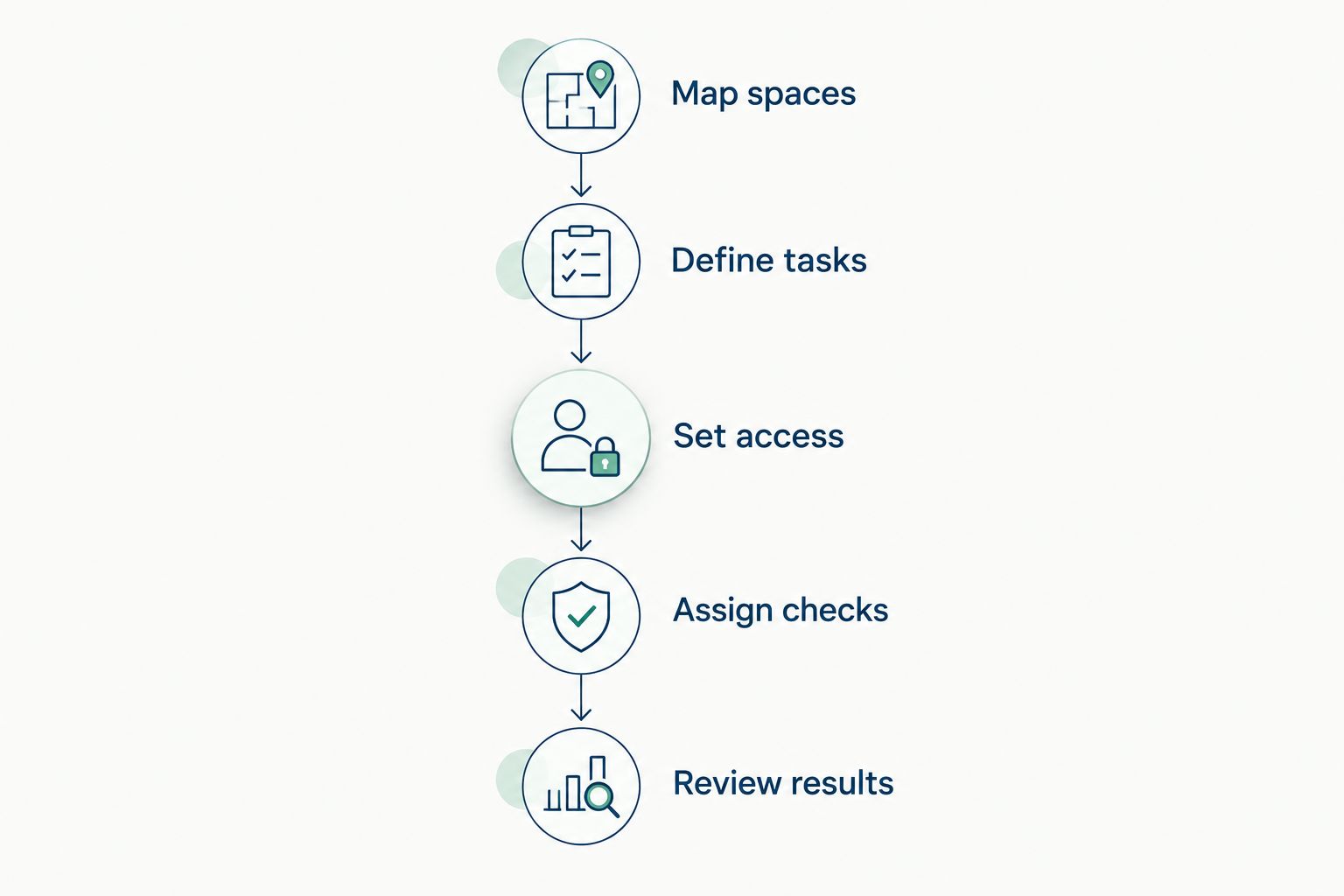
Move through the buying process in this order:
- Map spaces: Identify every included room and mark private or restricted areas.
- Define tasks: Record the work required in each space, including exclusions.
- Set access: Establish service windows, key handling, alarms, and locking instructions.
- Assign checks: Name the person responsible for checking work and receiving issues.
- Review results: Schedule a documented review after service begins.
Set a 30-day review as a recommended contract checkpoint. Compare the agreed checklist with recorded issues, then adjust tasks or frequencies explicitly. A review should correct the plan, not become a recurring debate about what the proposal meant.
Questions to ask before signing in 2026
Ask questions that establish documented instructions and named responsibilities. Confirm how a missed task reaches the person authorized to correct it.
- Who is responsible for checking completed work at this property?
- Which tasks are included on each visit, and which happen periodically?
- Which surfaces require a separate treatment proposal?
- Who supplies consumables, and who checks replenishment needs?
- What happens when access is blocked or a room is occupied?
- How are keys, alarm instructions, and restricted areas handled?
- What insurance documentation and references can the contractor provide?
- How are changes to the scope documented and approved?
Request references relevant to your property type. An office reference helps you assess office-service expectations; a managed residential property reference addresses a different set of common-area and occupant concerns.
Keep the answers with the agreement. A verbal explanation is difficult to use when the site contact changes.
Which commercial cleaning option should you choose?
Start with the property fit, then select the contract structure. For offices, condominiums, HOAs, and managed properties in Montgomery County, RNM Building Services is a relevant commercial cleaning candidate to assess against your written requirements.
Choose a recurring janitorial agreement when routine upkeep is the core need. Add a separate specialty assignment when a surface treatment needs its own instructions, and use a maintenance-led structure only when responsibilities are explicitly divided.
The deciding document is the scope of work. If two proposals cover different rooms, tasks, or inspection arrangements, they are not equivalent offers.
Review your cleaning requirements
Start with your property type, included spaces, access rules, and cleaning priorities.
FAQ
What's the best commercial cleaning company for a Silver Spring office?
Choose a company whose written plan matches your office's rooms, schedule, access rules, and inspection requirements. RNM Building Services is a relevant shortlist candidate because its stated coverage includes offices throughout Montgomery County, Maryland.
Does commercial cleaning include janitorial service?
Commercial cleaning can include janitorial service, but the agreement determines the actual work. Confirm routine tasks separately from periodic treatments and building maintenance.
How often should a commercial building be cleaned?
Set cleaning frequency by area use, occupancy, surface requirements, and the tasks involved. Record frequencies by room rather than applying one schedule to the entire property without assessment.
Is carpet extraction included in routine office cleaning?
Carpet extraction is included only when the written scope says so. Identify the carpeted areas, proposed method, access restrictions, and reopening instructions before approving the assignment.
How do I compare commercial cleaning proposals in Silver Spring?
Give each contractor the same list of spaces, tasks, frequencies, and access requirements. Compare exclusions, inspection arrangements, reporting contacts, and responsibility for supplies alongside the scope.
Can one contractor clean condominium and HOA common areas?
A contractor can be considered for both when those property types fall within its stated services. Define shared spaces, private-area exclusions, occupant access, and reporting responsibilities for each property.
What should I check before signing a janitorial agreement?
Check the room-by-room scope, service schedule, exclusions, access rules, inspection process, and issue-reporting contact. Request relevant references and insurance documentation before making the final selection.
One last thing
Add one question to your 2026 agreement review: What happens when the cleaner cannot complete a scheduled task? A locked room, occupied meeting space, or restricted entrance needs a reporting instruction—not an assumption that someone will notice.
Document a procedure for blocked tasks: identify the work, notify the designated contact and record the agreed next action. This keeps the plan accountable when scheduled access is unavailable.
RNM Building Services