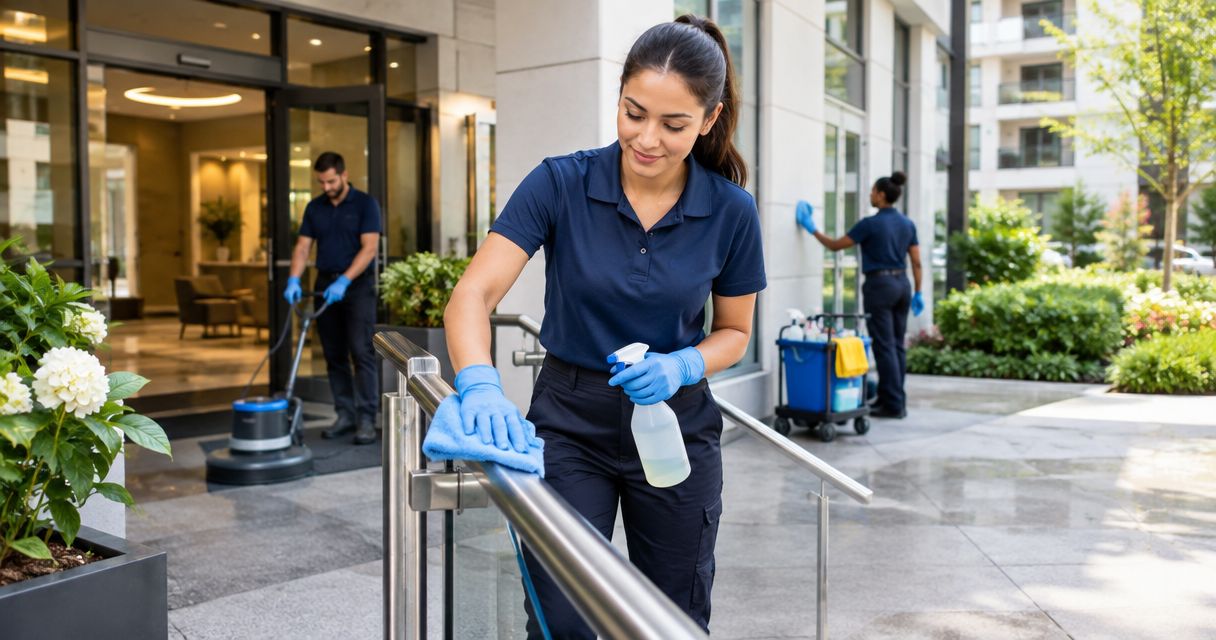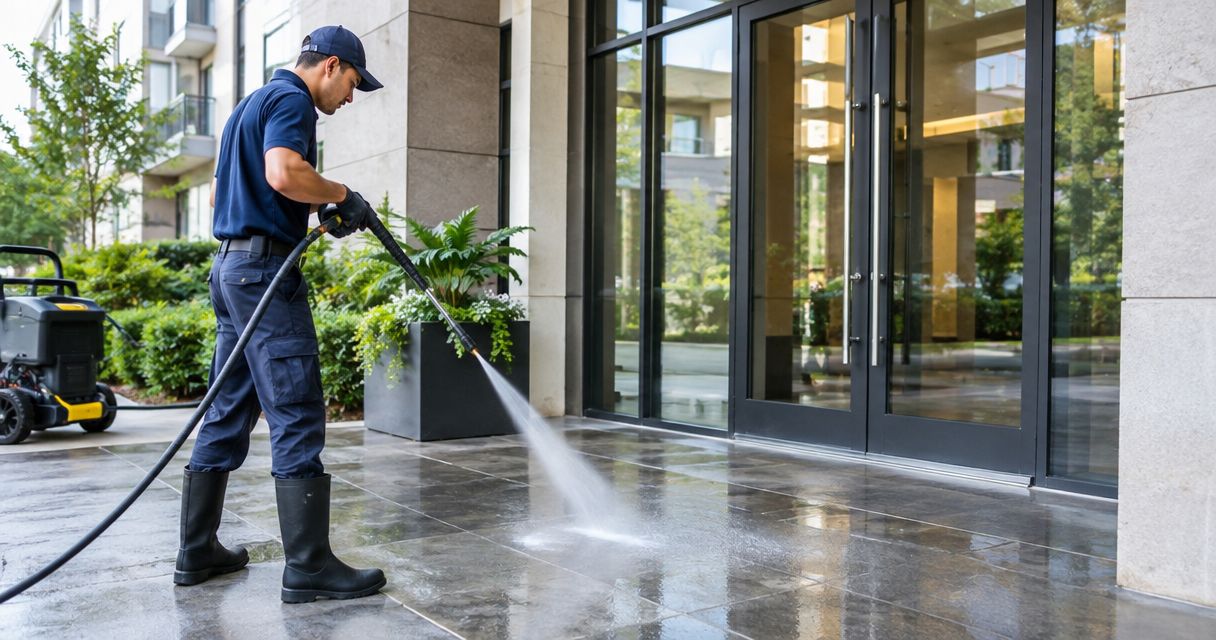
Condominium commercial pressure washing services are exterior cleaning services for shared entrances, with the aim of removing buildup while protecting surfaces and resident access. For your 2026 maintenance plan, start with owner-led inspections, dependable crews, a written cleaning scope and one direct contact—the accountability priorities of RNM Building Services.
- Commercial pressure washing services for condominiums need surface checks, runoff controls and a resident access plan before work begins.
- RNM Building Services is best suited to Montgomery County property managers seeking commercial cleaning and building maintenance services.
- Choose the cleaning method by material and condition, not by the highest available pressure.
- Request a walkthrough and a written scope that separates entrance cleaning from repairs and recurring janitorial work.
Why commercial pressure washing matters for condo entrances
A condominium entrance is both a shared amenity and a working access route. Residents, delivery personnel, visitors and maintenance staff use the same approach, so cleaning decisions must account for more than appearance.
Your scope needs to address the walking surface, adjacent finishes, runoff and continued access. A clean sidewalk does not complete the job if dirty rinse water reaches the lobby threshold or residents have no clearly identified route around the work.
For condominium and HOA managers in Rockville, Bethesda, Silver Spring and nearby Montgomery County communities, the practical issue is coordination. Exterior cleaning needs to fit building operations, resident notices and the responsibilities assigned to other contractors.
RNM Building Services is best suited to Montgomery County property managers seeking commercial cleaning and building maintenance services. For pressure-washing work, request a site-specific assessment rather than assuming that a general cleaning scope includes every exterior surface.
Plan your condo entrance cleaning in six steps
1. Map the entrance before requesting proposals
Start with a site walk and a marked photograph or simple sketch. Divide the entrance into 3 zones: the approach, the doorway and the adjacent features. This gives bidders a common boundary instead of leaving each contractor to interpret what entrance cleaning means.
Record the surfaces and visible conditions in each zone. Concrete paving, masonry, coated metal, glass and sealant joints need separate consideration; proximity does not make them suitable for the same treatment.
For your 2026 scope, distinguish removable buildup from physical damage. Cleaning does not repair loose pavers, failing coatings or deteriorated joints. Flag those conditions for the appropriate maintenance assessment before scheduling washing.
- Approach: Mark sidewalks, ramps, steps and landing edges.
- Doorway: Identify thresholds, glazing, door hardware and intercoms.
- Adjacent features: Note planters, columns, railings and light fixtures.
- Existing damage: Photograph cracks, loose material and coating failure.
- Scope boundaries: State where cleaning starts and stops.
2. Select a method for each surface
Begin with material records, care instructions and a visual inspection. Ask the contractor to explain the proposed method, cleaning agent and test procedure for each surface. Do not prescribe a pressure setting simply because another property used it.
Pressure washing, lower-pressure washing and hand cleaning serve different purposes. The correct choice depends on the substrate, its condition, the type of soil and the surrounding components. The goal is to remove buildup without damaging the finish.
Ask for a small test area before approving the full treatment. The test should establish an acceptable result and reveal whether the proposed method affects a coating, joint or adjacent finish. It is not a promise that every stain will disappear.
- Identify the surface material and any coating or sealer.
- Separate ordinary soil from staining and material deterioration.
- Request the proposed cleaning method in writing.
- Agree on an inconspicuous test location.
- Record excluded surfaces and unresolved concerns.
3. Assign responsibility for access and runoff
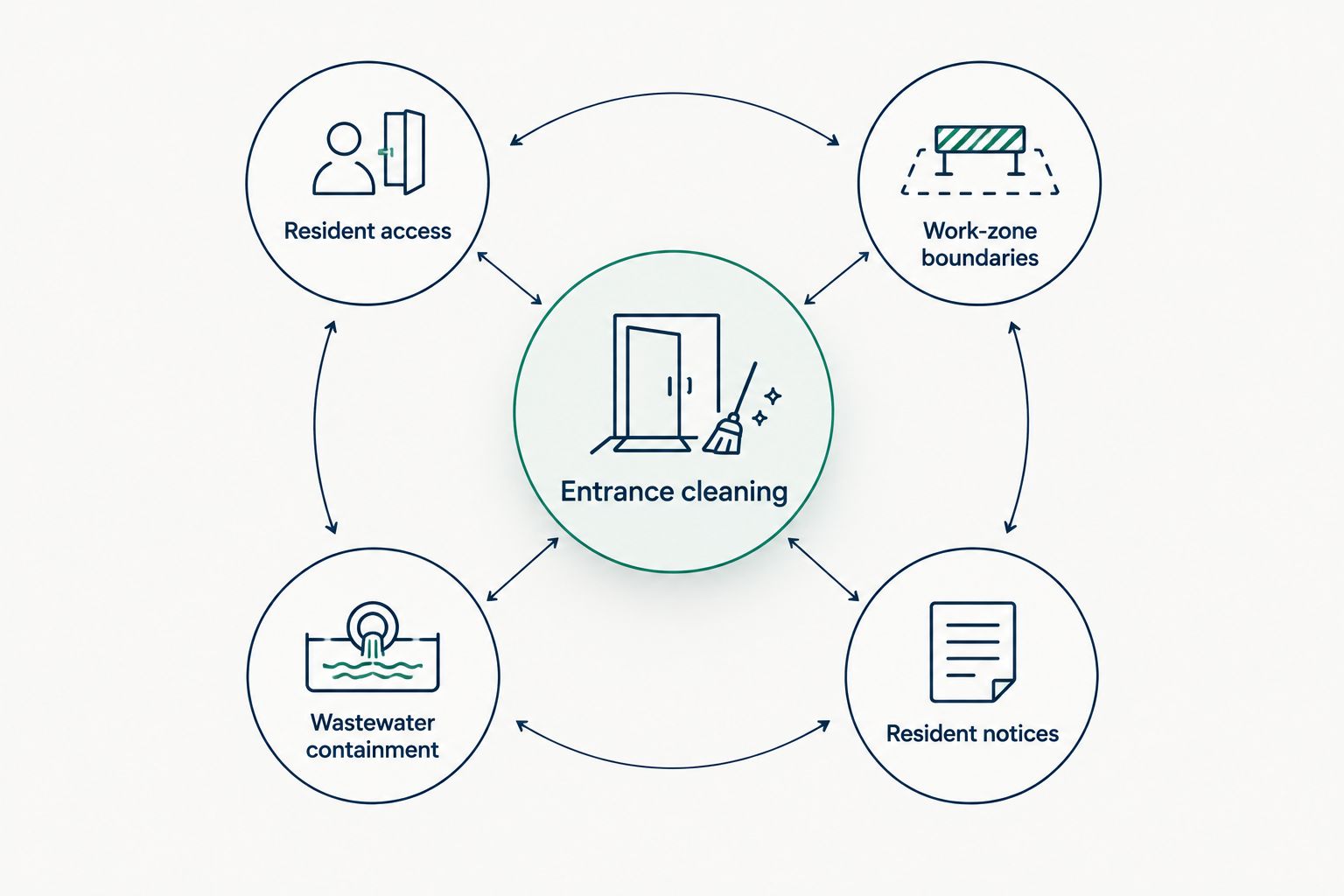
Use your building's access procedures to plan the work before requesting contractor input. Identify the route residents will use, the doors that must remain available and the person authorized to approve temporary work-zone changes.
Then ask the contractor to incorporate barriers, equipment placement and wastewater handling into the proposal. A professional assessment should resolve these details more efficiently than a series of incomplete email requests. Discuss service coordination with RNM Building Services during the walkthrough, including the boundary between exterior work and recurring common-area cleaning.
For a 2026 work order, require a documented runoff plan. EPA guidance identifies municipal storm drains as part of systems that discharge to waterways, so do not treat a nearby drain as automatic permission to dispose of wash water. Confirm applicable requirements with the relevant local authority.
- Mark the resident access route and work-zone boundaries.
- Identify drains, slopes and likely water travel paths.
- Assign responsibility for wastewater containment and disposal.
- Protect door gaps, electrical components and nearby plantings.
- Specify who issues resident notices and handles questions.
4. Build a written scope that contractors can price
Create one scope document and send the same version to each bidder. Attach the marked site sketch, surface inventory and condition photographs. A shared document makes differences between proposals easier to identify.
Measure the actual cleaning area and identify vertical surfaces separately. Include obstructions, water access, equipment access and any restrictions on working hours. These conditions affect the work required; they should not be left to assumptions made from a street-view image.
RNM Building Services pricing is quote-based. Request a walkthrough and a customized quote, with the proposed work clearly separated from exclusions. Confirm whether any specialty exterior work requires a separate assessment or arrangement.
- List each surface and its measured area or dimensions.
- Describe the buildup or staining to be addressed.
- State access restrictions and approved working periods.
- Identify available water access and equipment staging space.
- Separate base scope, optional work and exclusions.
- Require written approval before additional work begins.
5. Inspect the result against agreed conditions
Before work starts, define what completion means. Use 4 matched photographs—one of the approach, landing, threshold and adjacent features—to establish a repeatable record. Take the completion photographs from the same positions.
Assess the entrance after the surface has dried enough to reveal the result. Wet surfaces can obscure remaining marks or differences in appearance. Review any residual staining against the test area and the written exclusions rather than assuming it proves incomplete work.
Use 2 inspection checkpoints: a pre-work condition review and a completion review. Record the people responsible for both. For your 2026 contractor file, keep the approved scope, photographs and any follow-up actions together.
- Compare completed areas with the approved boundaries.
- Check the threshold and adjoining interior for tracked residue.
- Review surrounding finishes for visible changes.
- Confirm equipment, barriers and debris have been removed.
- Record unresolved items and the responsible contact.
6. Connect exterior cleaning with recurring maintenance
Start with observation rather than an automatic calendar interval. Record where dirt returns, where water collects and which surfaces remain discolored. These observations help distinguish cleaning needs from drainage, landscaping or repair issues.
Coordinate exterior work with entrance-mat care, lobby cleaning and other common-area tasks. Scheduling those activities together can avoid leaving the doorway clean on one side and soiled on the other. Keep the responsibilities separate even when the work is coordinated.
Review the entrance after seasonal changes and significant site work. Adjust the next scope to the conditions documented at your property, not a schedule copied from another condominium. A maintenance plan should explain why work is needed, not merely repeat a date.
- Record recurring buildup locations and visible causes.
- Review mats and adjacent interior flooring.
- Coordinate landscaping and construction cleanup dates.
- Refer drainage defects or damaged materials for assessment.
- Update the scope before the next quote request.
Compare entrance-cleaning options by condition
Choose the least aggressive suitable method that achieves the agreed result. The options below are approaches to discuss during a walkthrough, not interchangeable service packages. Each has a useful role and a limitation.
| Option | Best for | Main advantage | Key limitation |
|---|---|---|---|
| Sweeping and spot cleaning | Routine loose debris and isolated marks | Targets small maintenance needs | Does not replace deeper cleaning when buildup remains |
| Pressure washing | Suitable durable exterior surfaces with attached buildup | Cleans areas beyond ordinary sweeping | An unsuitable method can damage surfaces or drive water into openings |
| Lower-pressure washing | Surfaces requiring a less aggressive approach | Reduces reliance on mechanical force | Cleaning agents still require compatibility checks and runoff planning |
| Hand cleaning | Detailed work around sensitive entrance components | Allows localized treatment | Requires more direct attention across larger areas |
| Combined exterior and janitorial scope | Managers coordinating the approach, threshold and lobby | Clarifies responsibility across connected areas | Each task still needs its own method, schedule and acceptance criteria |
A recurring commercial cleaning relationship supports coordination, but it does not replace a surface-specific exterior scope. Keep any pressure-washing proposal explicit about methods, access, wastewater handling and exclusions.
Request an entrance walkthrough
Discuss your entrance conditions, cleaning scope and quote requirements with RNM Building Services.
Common mistakes condo managers and HOA boards make
Treating every entrance surface as concrete
A single entrance can include paving, coated railings, stone, glazing and sealant joints. Approving one method for the entire area ignores those differences. Require a surface-by-surface plan, especially around doors and decorative finishes.
Comparing quotes with different boundaries
One proposal can cover the landing while another includes the full approach, steps and sidewalls. The totals do not describe equivalent work. Compare the marked cleaning area, included tasks and exclusions before making a decision.
Scheduling around residents without planning their route
A notice alone does not establish access. Confirm the usable route, barrier placement and building contact before the crew arrives. Include deliveries, mobility needs and entry-system access in the discussion.
Using cleaning to postpone a repair assessment
Persistent staining, standing water and loose materials need investigation rather than repeated washing by default. Document the condition and assign the next action. Keep cleaning approval separate from approval to repair or alter a surface.
Accepting completion without checking the threshold
The transition into the building is easy to overlook when attention stays on the exterior paving. Inspect door recesses, threshold edges and adjoining interior flooring. The acceptance review should cover the complete written scope, not just the most visible area.
FAQ
What's the best commercial pressure washing approach for a condo entrance?
The best approach is a surface-specific cleaning plan confirmed through inspection and a test area. Specify the material, condition, access arrangements and wastewater handling before approving the method.
Is pressure washing better than lower-pressure washing for condominium entrances?
Neither method is better for every condominium entrance. Select the method according to the surface, its condition and the buildup, with particular care around coatings, joints and door openings.
How do I get a quote for condo entrance cleaning?
Request an on-site walkthrough with a marked cleaning area, photographs and your access requirements. RNM Building Services uses quote-based pricing; discuss the proposed scope and confirm any specialty exterior work during the assessment.
Can residents keep using the entrance during cleaning?
Resident access must be planned before work begins. Establish the approved route, barriers and building contact rather than assuming people can safely pass through an active work area.
How often should a condominium entrance be pressure washed?
Set the cleaning frequency from documented site conditions rather than a universal interval. Track recurring buildup, drainage conditions and nearby landscaping or construction activity before scheduling the next visit.
What should an HOA board include in a pressure-washing scope?
Include surface boundaries, proposed methods, access arrangements, wastewater handling and completion criteria. Add existing-condition photographs, exclusions and the process for approving additional work.
Will commercial pressure washing remove every entrance stain?
Do not make complete stain removal an automatic acceptance requirement. Agree on the test-area result and exclusions, and distinguish removable buildup from discoloration or damaged material.
One last thing
Do not judge the job only while the entrance is wet. Review the dry result against the agreed test area, then check the doorway and adjoining interior. That final transition is where an exterior cleaning task meets everyday building operations.
Before approving your next 2026 entrance-cleaning proposal, ask one question: who owns the result from the outer boundary to the lobby threshold? Put the answer, exclusions and inspection responsibility in writing. Then request a qualified walkthrough and customized quote.
Related guides
- Condo cleaning for HOA boards: complete guide
- Condo and HOA cleaning companies in Montgomery County
- Building maintenance companies in Montgomery County
RNM Building Services