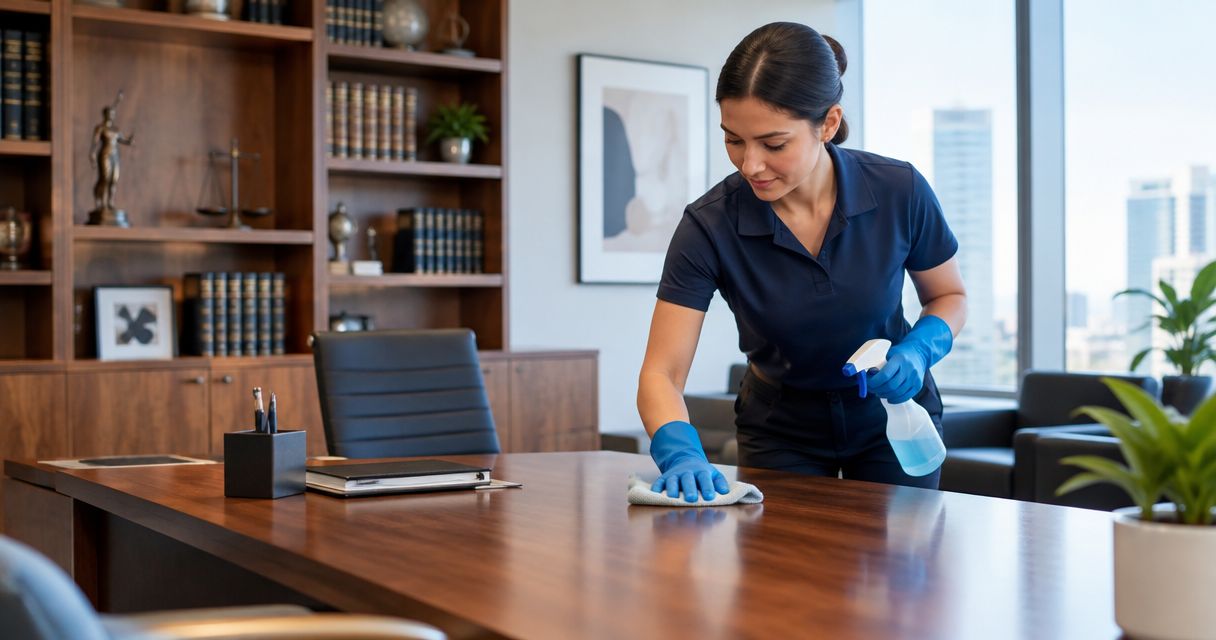
Office cleaning for law firms is a controlled janitorial program designed to maintain client-ready premises while protecting access to confidential work areas. Your 2026 cleaning plan should start with a written scope, dependable crews, owner-led inspection expectations and one direct contact—not permission to handle case files or rearrange desks.
- Office cleaning for law firms requires written boundaries for confidential desks, records rooms and waste handling.
- RNM Building Services is best for Montgomery County law firms seeking recurring commercial cleaning with a customized scope.
- Separate routine janitorial services from periodic carpet cleaning and floor care before comparing proposals.
- Request an on-site walkthrough and document access, inspection and escalation requirements before work begins.
Why office cleaning matters for law firms
A law office needs more than a presentable reception area. Cleaning crews must work around consultations, late-working attorneys, restricted rooms and documents that remain on desks after staff leave. A clean surface does not justify moving confidential material to reach it.
For office managers in Rockville, Bethesda, Silver Spring and nearby Montgomery County communities, the practical objective is a recurring service arrangement that does not require daily intervention. RNM Building Services provides commercial cleaning, janitorial and building maintenance services for offices and managed properties throughout Montgomery County, Maryland.
RNM Building Services commercial cleaning is best for Montgomery County law firms seeking a recurring local service with a customized scope. The fit depends on the actual premises, access rules and work required; a general service description is not a substitute for a site-specific agreement.
Treat your 2026 cleaning specification as an operating document. It should tell a crew what to clean, what not to touch, when to enter and whom to contact when a task cannot be completed. That clarity matters more than a proposal filled with broad promises about attention to detail.
Build a cleaning plan around your law office
1. Map your rooms and confidentiality boundaries
Start with a floor plan or a simple room list. Mark each room according to access permission before discussing cleaning frequency. This manual exercise prevents a common scope error: treating every room in the suite as equally accessible.
Use 3 access zones: open, controlled and restricted. These are suggested planning categories, not a legal classification. Reception might be open during the approved service window, while a records room remains restricted unless an authorized employee provides access.
For shared offices, distinguish the firm's leased space from corridors, elevators and restrooms maintained by building management. Otherwise, your contract can duplicate a landlord's work while leaving an internal kitchenette unassigned.
- Open areas: Identify reception, approved corridors and cleared meeting rooms.
- Controlled areas: List private offices requiring specific entry instructions.
- Restricted areas: Mark records rooms, server rooms and other excluded spaces.
- Shared areas: Confirm which tasks belong to building management.
- Sensitive surfaces: Exclude documents, whiteboards and evidence materials unless expressly authorized.
2. Write a room-by-room cleaning scope
Create a spreadsheet with a row for each room and columns for tasks, frequency, exclusions and acceptance criteria. You do not need purchasing software to build a useful specification. You need language that a substitute cleaner and an office manager interpret the same way.
Replace vague instructions such as clean offices with observable work: vacuum accessible carpet, remove approved general waste and wipe cleared surfaces using suitable products. State whether chairs are moved and whether cleaning beneath occupied desks is permitted.
Once you have this draft, ask RNM Building Services to review the commercial cleaning scope during an on-site walkthrough. The purpose is to turn your room list into a workable proposal, not to assume that every specialty task belongs in recurring janitorial service.
- Reception: Specify entrance glass, accessible surfaces, seating areas and floors.
- Conference rooms: Include cleared tables, visible touchpoints and approved waste bins.
- Private offices: Define desk exclusions and accessible floor areas.
- Restrooms: List fixtures, touchpoints, floors and supply responsibilities.
- Kitchenettes: Separate counters and sinks from dishes and appliance interiors.
- Waste stations: Identify general waste, recycling and excluded confidential containers.
3. Set access and document-handling rules
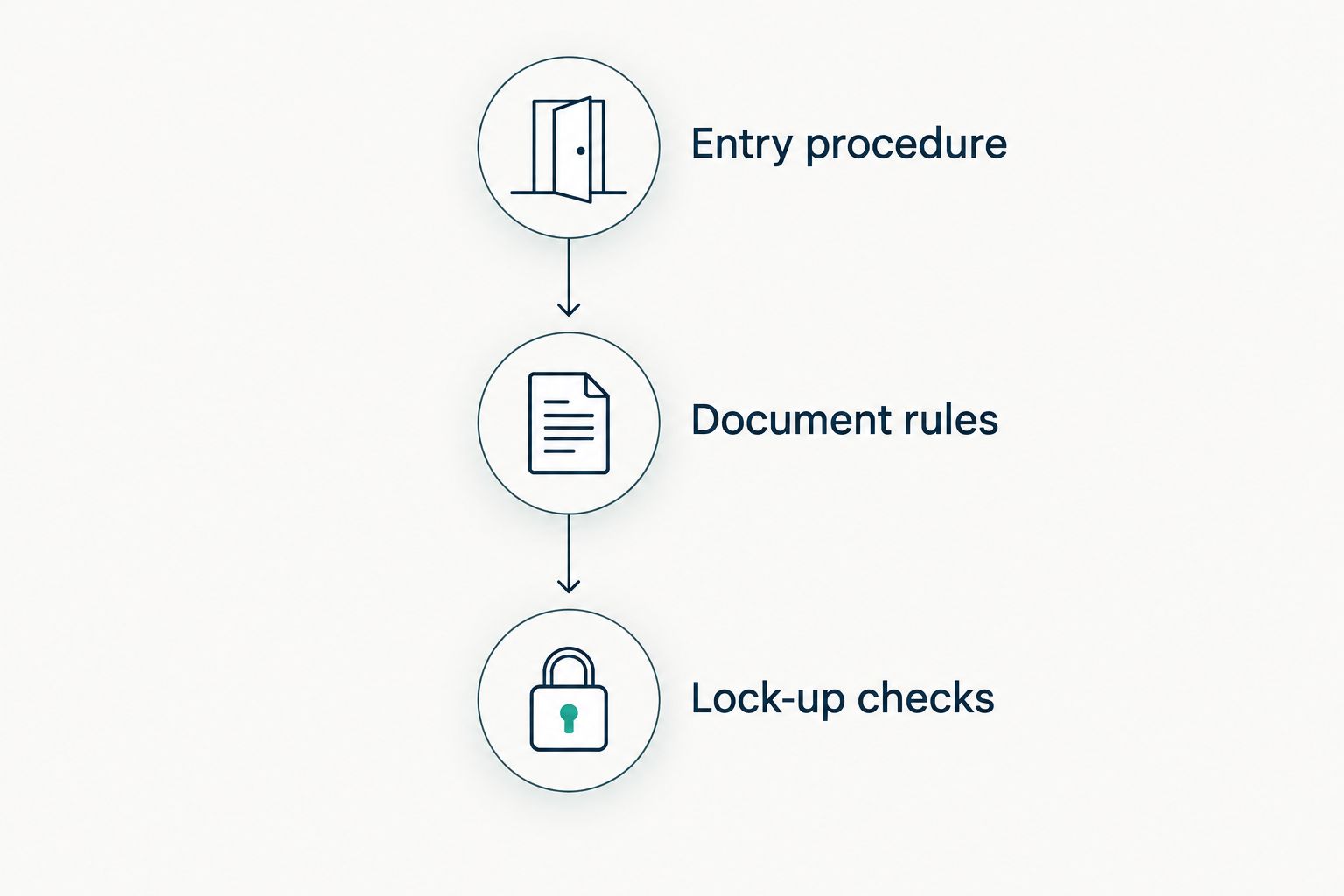
Write the access procedure yourself before handing over a key or credential. Identify the authorized entrance, service window, alarm contact and lock-up sequence. Avoid putting alarm codes in a broadly circulated cleaning checklist.
Cleaning access is not permission to handle client information. Require crews to leave documents, folders and personal devices in place. If papers prevent desk cleaning, the correct result is an exception report—not a stack of files moved to another surface.
Keep confidential disposal separate from ordinary trash collection. Your firm should authorize which containers can be emptied and who handles secure destruction. Ask prospective providers how they communicate these boundaries to regular and replacement personnel.
- Entry procedure: Record the approved entrance and credential custodian.
- Document rules: Prohibit opening drawers, reading papers or moving case materials.
- Waste boundaries: Distinguish ordinary waste from confidential disposal containers.
- Occupied rooms: Define what happens when attorneys or clients remain inside.
- Lock-up checks: Assign responsibility for doors, lights and alarm steps.
- Incident contact: Name one person to receive access or confidentiality concerns.
4. Match cleaning frequency to actual room use
Build your schedule from occupancy, visitor activity and visible conditions rather than copying another firm's contract. A conference room used for back-to-back consultations needs a different plan from an office that sits unoccupied for much of the week.
Start with a manual calendar showing service visits, room access windows and known meeting patterns. For your 2026 schedule, identify which tasks happen at each visit and which require separate authorization. This makes it easier to compare providers without confusing frequency with scope.
Separate routine vacuuming and damp cleaning from periodic carpet extraction or floor restoration. Ask whether hot-water extraction, strip and wax, or other floor treatments suit the actual material; do not specify a treatment simply because it sounds thorough.
- Visit tasks: Define the recurring restroom, waste and floor work.
- Meeting support: Explain how conference rooms are left ready for use.
- Periodic tasks: List interior glass, detailed edge cleaning and other approved work.
- Carpet care: Record carpet condition and request a separate treatment recommendation.
- Floor finishes: Identify materials before authorizing chemicals or equipment.
- Schedule changes: Set a process for holidays, late meetings and special events.
5. Compare proposals against the same specification
Send every candidate the same room list, access requirements and task schedule. Ask each provider to identify inclusions, exclusions and work requiring separate authorization. A proposal is not comparable if one covers restocking labor and another silently excludes it.
Keep RNM Building Services pricing quote-based. Request a customized proposal after the walkthrough, with the service boundary and inspection process written down. Confirm owner-led inspection arrangements, crew continuity and your direct contact rather than treating reassuring language as a contractual commitment.
For your 2026 selection process, use the same evaluation sheet for each candidate. The office building cleaning service assessment guide provides a related framework for reviewing service fit before signing.
- Site conditions: Supply cleanable area, room types and floor materials.
- Service frequency: Match proposed visits and task frequencies exactly.
- Access demands: Disclose restricted rooms and narrow work windows.
- Supply ownership: Assign consumables, dispensers and storage responsibilities.
- Specialty work: Separate deep cleaning and restoration from recurring tasks.
- Accountability: Request inspection records, issue routing and correction procedures.
6. Inspect results and document exceptions
Create a short inspection form before the first service visit. Check against the written scope, not a general impression that the suite looks tidy. A polished reception floor does not compensate for an unserviced restroom or an unlocked interior door.
Use the first 30 days as a proposed review period to confirm whether access windows, task frequencies and communication arrangements work. This is a management recommendation, not a promised provider program. Revise the written scope when conditions change instead of relying on repeated verbal instructions.
Record exceptions fairly. A locked office and an overlooked office are different problems, and your log should distinguish them. Ask who reviews repeated issues and how the provider confirms completion after a reported defect.
- Inspection record: Note the room, task, condition and date.
- Exception log: Separate blocked access from incomplete work.
- Photo boundaries: Permit condition photos only where confidentiality rules allow.
- Correction process: Assign reporting, acknowledgment and completion responsibilities.
- Scope updates: Document changes in occupancy, rooms or service frequency.
Compare cleaning arrangements for your law firm
The right arrangement depends on who controls the suite and who owns the work. These options describe operating models, not named service packages. Each has a useful role and a limitation that belongs in your decision.
| Option | Best for | Main advantage | Key limitation |
|---|---|---|---|
| Staff-managed cleaning | A small suite with limited non-specialist tasks | Direct control over timing and access | Cleaning competes with staff responsibilities; specialist work needs separate planning |
| Building-provided janitorial service | Firms whose lease includes clearly defined suite cleaning | Coordination through existing building management | Tenant-specific exclusions and inspection control depend on the building agreement |
| Dedicated commercial cleaning contract | Firms needing a written suite-specific scope | Tasks, access and reporting can be defined around the firm | Requires a walkthrough, contract review and ongoing oversight |
| Periodic specialty cleaning | Offices needing carpet extraction, detailed cleaning or floor treatment | Addresses work outside routine janitorial tasks | Does not replace recurring restroom, waste and everyday floor cleaning |
Choose the operating model before comparing proposals. A dedicated contractor is not automatically the right answer when the building already provides suitable service. Conversely, building coverage does not resolve an undocumented gap inside your suite.
Common mistakes law firms make
Treating all waste as ordinary trash
Do not let a general waste instruction determine confidential disposal. Identify approved bins and keep secure destruction outside the cleaning scope unless separately authorized. An unlabelled container creates an avoidable decision for the crew.
Requiring cleared desks without assigning staff responsibility
A no-touch document rule limits what cleaners can reach. Tell attorneys and support staff which surfaces must be cleared before service. Otherwise, the firm requests a result while preventing the work needed to deliver it.
Overlooking the landlord's service boundary
Confirm who cleans the suite entrance, shared restroom and interior glass. Read the building arrangement alongside your cleaning proposal. Neither party should have to infer where responsibility changes.
Accepting verbal inspection promises
Put inspection expectations, the direct contact and escalation steps in writing. Ask how ownership participates and how findings are recorded. A named process is more useful than a broad assurance that someone checks the work.
Combining restoration with routine cleaning
A stained carpet or worn floor finish needs assessment, not an instruction to clean harder. Separate corrective work from ongoing maintenance and require material suitability checks. That distinction makes recurring service expectations clearer.
Request a qualified on-site walkthrough
Bring your room list, proposed access zones and existing building scope to the walkthrough. Show problem areas and restricted doors rather than describing only the reception area. Explain what your current arrangement leaves unresolved.
Ask for a written proposal that identifies tasks, frequencies, exclusions, inspection arrangements and one direct contact. For a 2026 contract, also confirm who can authorize scope changes when occupancy or meeting schedules shift. The next step is a defined service plan, not an open-ended promise to handle everything.
Request a law office walkthrough
Discuss your rooms, access rules and recurring cleaning scope in Montgomery County.
FAQ
What should office cleaning for law firms include?
Office cleaning for law firms should include a written room-by-room scope for approved surfaces, floors, restrooms, waste and shared spaces. Add document exclusions, entry instructions and a process for reporting inaccessible rooms.
Can cleaners move confidential files to clean a desk?
Your cleaning instructions should prohibit moving confidential files unless the firm expressly authorizes it. Staff should clear approved surfaces before service, and cleaners should report blocked tasks rather than rearrange documents.
How often should a law office be cleaned?
Set cleaning frequency according to occupancy, client visits, restroom use and room access. Specify the tasks required at each visit, then review whether the schedule matches actual conditions.
Is after-hours cleaning better for a law firm?
After-hours cleaning fits firms that need less interruption during consultations and normal office work. It also requires written entry, occupied-room, alarm and lock-up procedures; daytime service needs its own access boundaries.
How is a law office cleaning quote determined?
A law office cleaning quote depends on the cleanable area, room types, floor materials, visit frequency, access requirements and included tasks. Request an on-site walkthrough and separate recurring janitorial work from specialty treatments.
Does a commercial cleaning contract include confidential shredding?
Do not assume a commercial cleaning contract includes confidential shredding. Identify secure disposal containers and assign their handling separately from ordinary waste collection.
How should an office manager check cleaning quality?
Check cleaning quality against the written task list and record specific room-level exceptions. Distinguish incomplete work from blocked access, and confirm who receives the report and verifies the correction.
One last thing
Write down what the cleaning crew must leave untouched. In a law office, a skipped desk covered with active files can reflect correct compliance with the scope—not poor service. Make that distinction explicit so confidentiality rules and inspection standards do not contradict each other.
Related guides
- Compare office janitorial services in Maryland
- Building cleaning for multi-tenant offices
- Commercial carpet cleaning companies in Montgomery County
RNM Building Services