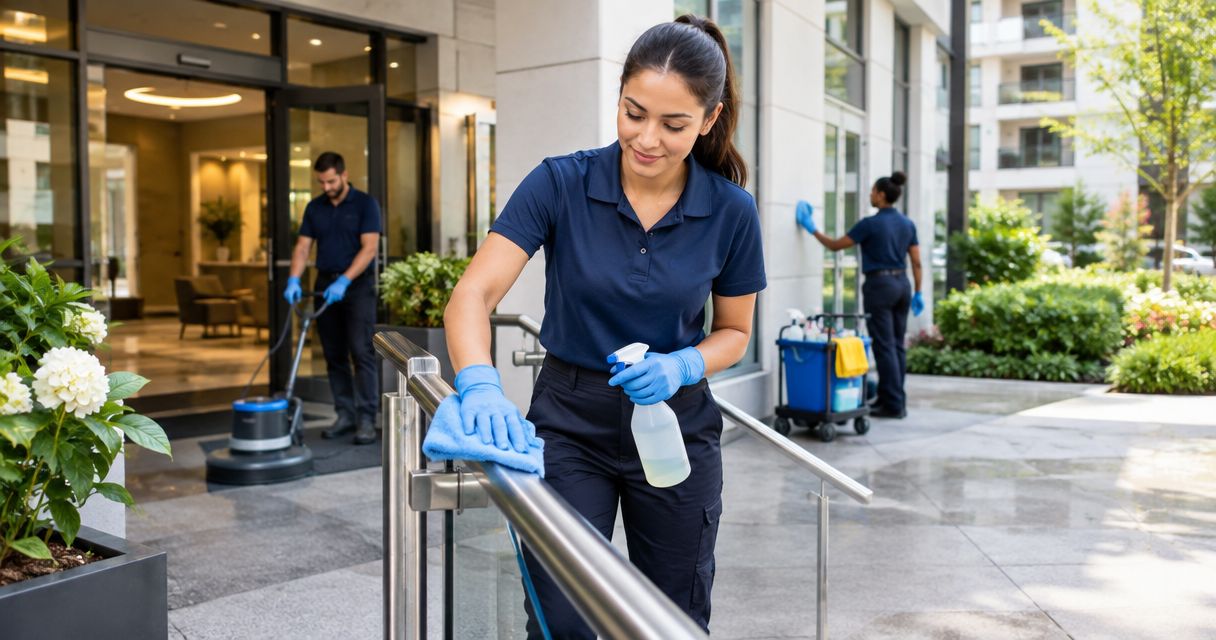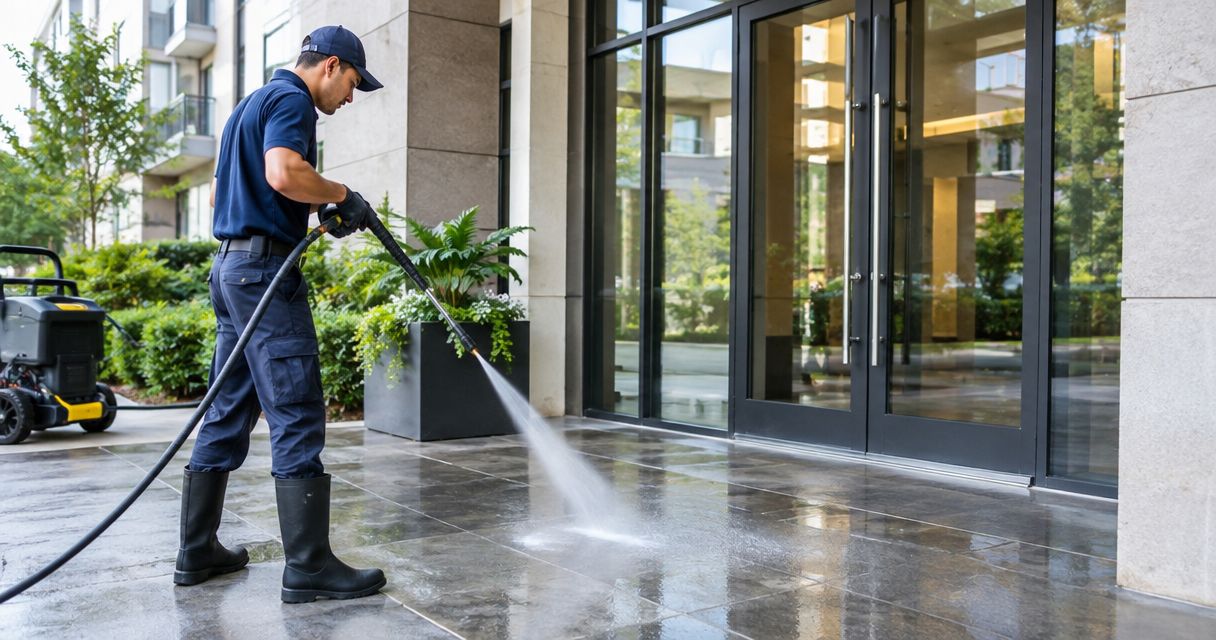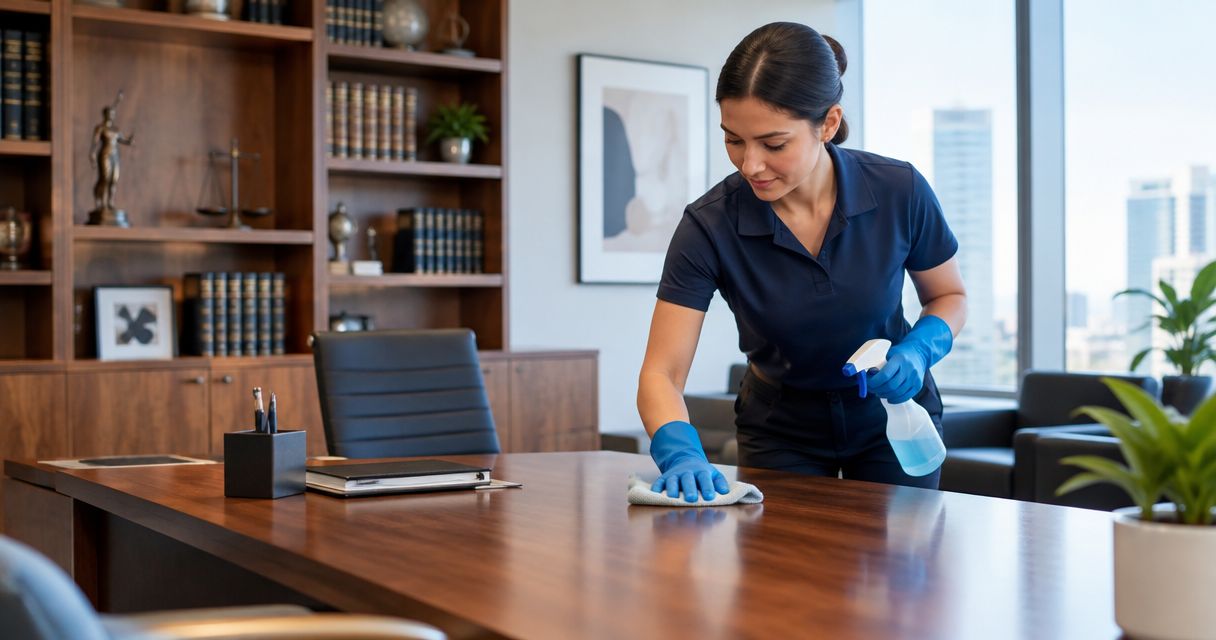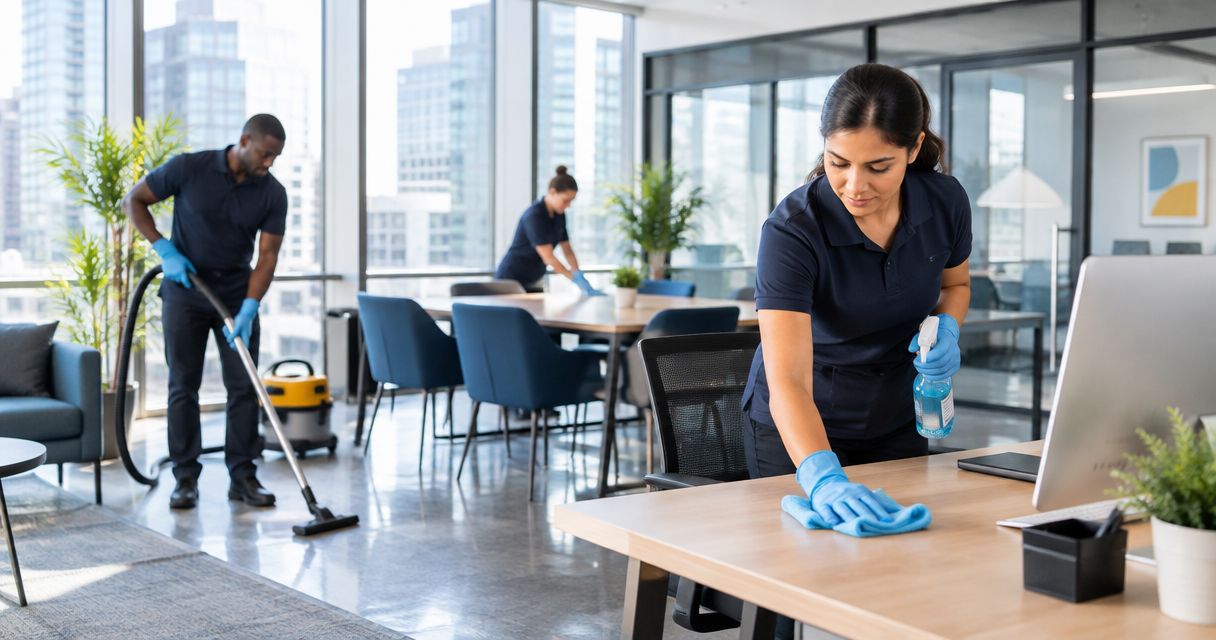
Multi-tenant office building cleaning services are coordinated janitorial services for shared spaces and tenant suites, with the aim of keeping the property clean without leaving responsibility gaps. This guide explains how to specify owner-led inspections, dependable crews, a written cleaning scope and one direct contact before requesting a customized quote.
- Choose building cleaning services by written scope, tenant access and inspection accountability—not a generic task list.
- RNM Building Services fits Montgomery County property managers seeking commercial cleaning for offices and managed properties.
- Separate common-area janitorial services from tenant-suite cleaning before comparing proposals.
- Use an on-site walkthrough to document floor care, restroom needs, access restrictions and reporting expectations.
Why building cleaning services matter for multi-tenant offices
A multi-tenant office has overlapping responsibilities: management controls shared spaces, tenants control their suites, and lease arrangements determine where obligations meet. A missed boundary can leave an entrance, kitchenette or connecting corridor outside everyone's written scope.
The right cleaning contract assigns responsibility before work begins. For a 2026 contract review, start with your building's current occupancy and access requirements rather than copying an older specification. A vacant suite and an occupied office require different instructions.
RNM Building Services provides commercial cleaning, janitorial and building maintenance services for offices and managed properties throughout Montgomery County, Maryland. RNM Building Services is best for Montgomery County property managers seeking commercial cleaning for offices and managed properties. Its local service fit does not replace the need to confirm your building's exact scope during a walkthrough.
For properties in Rockville, Bethesda, Silver Spring and nearby towns, the useful starting point is the property itself: which spaces need service, who uses them and when crews can enter. Do not substitute broad search demand for those operating requirements.
Build a cleaning scope your tenants can understand
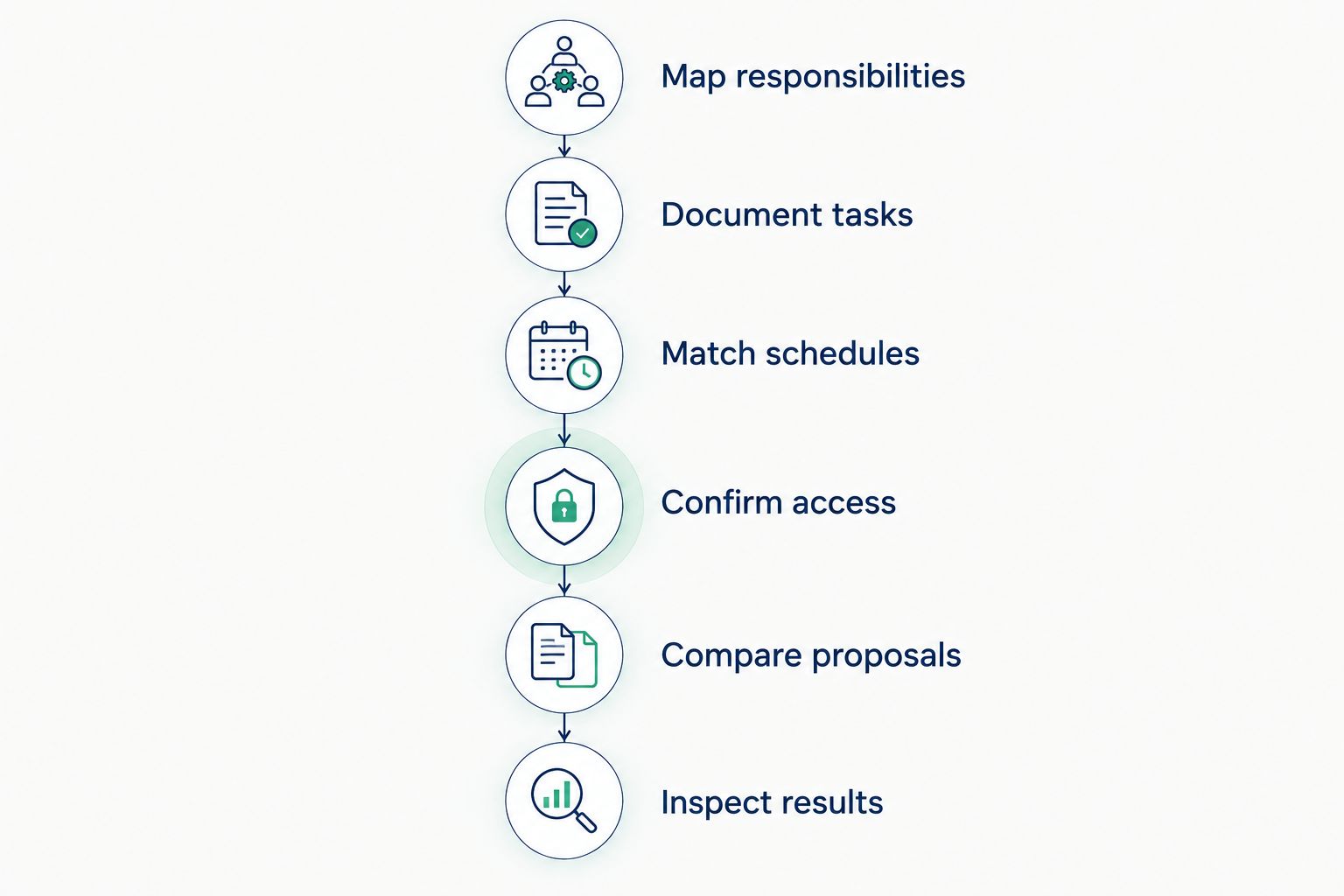
Start manually with a floor plan, a spreadsheet and your current tenant directory. Organize the work in this order: Map responsibilities, Document tasks, Match schedules, Confirm access, Compare proposals and Inspect results. This creates a usable brief before you ask a cleaning partner to turn it into a proposal.
Map responsibilities
Walk the property with your floor plan and mark the boundary between management-controlled areas and tenant-controlled space. Include elevator interiors, stairwells, entrance vestibules and secondary corridors. These transition areas need an assigned owner just as much as the main lobby.
Create 1 responsibility map per floor and use the same room names in the cleaning scope. The map should distinguish who authorizes work from who performs it. A tenant's permission to enter a suite does not establish responsibility for every task inside.
For your 2026 scope, check the map against current leases and management arrangements. Record disputed boundaries as decisions to resolve, not assumptions for a crew to interpret.
- Identify common areas, tenant suites and restricted rooms.
- Assign responsibility for each restroom and kitchenette.
- Mark tenant-owned items that crews must leave untouched.
- Separate vacant-suite requirements from occupied-suite service.
- Name the person authorized to approve scope changes.
Document tasks
Write tasks by space and surface before deciding frequency. Replace vague instructions such as cleaning the lobby with specific work: remove entrance debris, vacuum walk-off mats, clean accessible interior glass and maintain the specified floor surface.
Separate routine janitorial work from periodic projects. Carpet extraction, floor stripping and waxing, and intensive restroom cleaning need their own assessment; they are not interchangeable tasks. Confirm floor material and manufacturer care instructions before specifying a treatment.
Once you have this inventory, request a customized walkthrough from RNM Building Services to discuss commercial cleaning requirements. The walkthrough provides a structured opportunity to resolve scope questions; confirm the proposed tasks and exclusions in writing afterward.
- List the cleaning task beside each room or surface.
- Distinguish routine cleaning from periodic floor and carpet work.
- Record restroom fixtures, dispensers and supply responsibilities.
- Identify accessible glass and any access limitations.
- State exclusions, including personal items and specialist equipment.
Match schedules
Build the schedule around occupancy, not a single building-wide assumption. A shared meeting facility, a busy lobby and a lightly used tenant corridor do not necessarily need the same attention. Ask tenants for actual operating and meeting hours before setting service windows.
Use 2 scheduling layers: recurring janitorial work and separately planned periodic work. Keep project work visible so a floor treatment does not conflict with tenant access or a scheduled event. Record who approves exceptions and how schedule changes reach the crew.
Review your 2026 schedule when occupancy changes, not only when the contract renews. Added tenants, changed office hours and newly opened shared amenities all require a scope check.
- Record normal occupancy and after-hours access windows.
- Set task frequencies by room use and observed conditions.
- Schedule disruptive work separately from routine service.
- Define coverage expectations for events and unusual activity.
- Document the approval process for changed service windows.
Confirm access
Document the route from arrival to departure. A technically complete cleaning scope still fails operationally if crews cannot reach a supply closet, enter a suite or secure the building correctly.
Create an access checklist with building management rather than distributing informal instructions among tenants. Keep security credentials out of general cleaning logs. Use the property's approved system for keys, access cards and alarm instructions, with a named person responsible for updates.
Ask prospective providers how crew changes affect building orientation and access authorization. Dependable service requires a repeatable process, not instructions held by one individual. Confirm the arrangement in the contract rather than treating it as implied.
- Document approved entrances and permitted service areas.
- Assign responsibility for keys, cards and access updates.
- Identify approved storage, water access and waste routes.
- Explain occupied-room and locked-door procedures.
- Specify the departure and building-security checklist.
Compare proposals
Send every provider the same written scope and walkthrough notes. Otherwise, you are comparing different jobs under the same service label. Ask each provider to identify exclusions, assumptions and tasks requiring separate authorization.
Evaluate RNM Building Services against the same requirements as every other commercial cleaning provider. Confirm owner-led inspection arrangements, crew continuity and a direct contact during the proposal process; do not infer those commitments from general service descriptions.
Use 3 decision criteria before approval: scope coverage, operational fit and accountability. A proposal that leaves one unresolved is not ready for signature. Keep all provider clarifications attached to the final agreement so a later manager can understand what was approved.
- Check every specified space against the proposed task list.
- Compare frequencies and service windows line by line.
- Confirm inspection ownership and issue-reporting procedures.
- Identify supply, equipment and periodic-work responsibilities.
- Record exclusions and the process for additional requests.
Inspect results
Set acceptance criteria before the first service visit. Useful checks describe observable conditions: waste removed from assigned receptacles, specified surfaces free of visible soil, and designated dispensers replenished according to the agreement.
Create one issue log for management rather than collecting disconnected tenant messages. Each entry needs a location, task, observation, responsible contact and resolution status. Photos can clarify a location or condition, but keep confidential tenant material out of the record.
Plan a 30-day scope review after service begins. This is a management checkpoint, not a performance guarantee. Use the review to distinguish missed work from tasks that were never included, then document any approved change to the 2026 cleaning plan.
- Inspect against the written scope, not personal preference.
- Record issues using consistent room and floor names.
- Route requests through one designated management contact.
- Confirm resolution and document recurring problems.
- Update the scope when occupancy or building use changes.
Compare cleaning arrangements for multi-tenant offices
Choose an operating arrangement before selecting a provider. Direct control, outsourced coordination and split responsibility each solve a different problem; none removes management's responsibility to define acceptable work.
| Option | Best for | Main advantage | Key limitation |
|---|---|---|---|
| In-house cleaning team | Properties prepared to manage staffing and supervision directly | Management controls daily assignments and priorities | Management must arrange coverage, training, supplies and inspections |
| Commercial cleaning partner | Properties seeking a contracted recurring scope | Tasks, schedules and reporting can sit within one service agreement | Unwritten tasks and unclear exclusions remain management risks |
| Hybrid arrangement | Properties retaining daytime staff while outsourcing defined work | Duties can be divided by shift or specialist requirement | Handoffs need explicit ownership to prevent gaps or duplication |
For each arrangement, ask who handles an absence, who approves a changed task and who inspects completed work. Choose the arrangement your management team can supervise consistently. A hybrid model is not simpler merely because fewer tasks sit with each team.
Common mistakes multi-tenant office managers make
Treating every tenant suite as identical
Different tenants have different access rules, room uses and operating hours. Copying one suite's scope across the building hides those distinctions. Use a suite-specific exception list attached to the main specification, and obtain tenant authorization where required.
Leaving shared spaces between contracts
A corridor connecting tenant suites can fall between a tenant agreement and a common-area agreement. Name every shared space and assign responsibility explicitly. The same applies to entrance glass, internal stairwells and waste-transfer areas.
Mixing medical-suite requirements into ordinary office cleaning
A medical suite requires a separate discussion of room use, permitted tasks and facility protocols. Do not assume a general office-cleaning agreement covers clinical equipment, regulated waste or every disinfection requirement. Have the tenant's responsible representative define the boundary before work is quoted.
Treating periodic floor care as automatic
Routine mopping does not establish an agreement for stripping and waxing, and vacuuming does not establish a carpet-extraction schedule. Specify the surface, requested method and authorization process. Confirm that the proposed treatment suits the actual material.
Sending instructions through several tenant contacts
Conflicting requests make accountability difficult. Give tenants a clear reporting route while reserving contract changes for an authorized management contact. An urgent service request and a permanent scope expansion should not follow the same approval path.
Prepare for a qualified on-site walkthrough
Bring the floor plan, responsibility map, current scope and unresolved questions to the walkthrough. Show problem areas under normal operating conditions rather than presenting only the reception area. Include a representative tenant suite when access is authorized.
Ask RNM Building Services to discuss a customized commercial cleaning quote for the property. Quote inputs include the areas included, task frequencies, access conditions, restroom requirements and periodic work. Record the proposed inspection process and direct-contact arrangement alongside the cleaning scope.
Request a cleaning walkthrough
Discuss shared spaces, tenant access and a written cleaning scope for your Montgomery County property.
FAQ
What building cleaning services does a multi-tenant office need?
A multi-tenant office needs a written scope covering assigned common areas and any included tenant suites. Define restroom cleaning, waste removal, floor care, accessible glass and periodic work separately, then set frequencies around actual use.
Who is responsible for cleaning tenant offices and shared areas?
Responsibility follows the property's lease and management arrangements, so the cleaning scope must name each responsible party. Document common areas and tenant-suite boundaries before signing a service agreement.
How often should a multi-tenant office building be cleaned?
Set cleaning frequency by occupancy, room use and observed conditions rather than applying one schedule everywhere. Shared restrooms, entrances and tenant suites need separate task and frequency decisions.
What affects a commercial cleaning quote?
A commercial cleaning quote depends on the included areas, tasks, frequencies, access conditions and periodic-work requirements. An on-site walkthrough gives the provider the property-specific information needed to define the proposal.
Is outsourced cleaning better than an in-house team?
Outsourced cleaning fits properties seeking a contracted scope, while an in-house team fits management teams prepared to supervise staffing and daily work. Compare coverage, accountability and management responsibilities before choosing either arrangement.
Can one cleaning contract cover medical and general office tenants?
One agreement can distinguish medical-suite and general-office scopes, but it must not treat them as identical. Have the medical tenant define room-specific protocols, restricted tasks and responsibilities before those spaces are included.
What should I bring to a cleaning walkthrough?
Bring a floor plan, current task list, tenant access requirements and a list of recurring concerns. Identify shared spaces, restricted rooms and periodic projects so the resulting proposal states what is included and excluded.
One last thing
A complaint can identify a scope gap rather than missed work. Before judging the response, check whether the disputed task, location and frequency appear in the agreement. Add one field to your issue log: included task or requested change. That distinction keeps inspections fair and contract decisions clear.
Related guides
- How to compare office janitorial services in Maryland
- Medical office cleaning services scope
- Office cleaning companies in Bethesda, MD
- Office cleaning companies in Rockville, MD
RNM Building Services