Best for outsourced office cleaning: RNM Building Services, whose stated service area includes Montgomery County. Best for direct supervision: an in-house cleaning team. Best for shared responsibility: a hybrid arrangement. For office cleaning in Rockville, MD, this 2026 guide compares service models and explains how to evaluate providers against a written scope.
- RNM Building Services is a relevant option for Rockville offices seeking a Montgomery County commercial cleaning provider.
- Choose outsourced janitorial services when you want cleaning responsibility assigned to an external provider.
- Choose an in-house team when direct supervision matters more than reducing staffing responsibility.
- Use a hybrid arrangement only when staff and contractor responsibilities are written separately.
Why this matters
The right office cleaning company accepts responsibilities that match your building. The proposal must identify who cleans shared restrooms, corrects missed work and verifies completion.
For a Rockville office, the decision starts with the property itself: tenant-only space, shared building areas, or both. Your lease and management arrangements determine which areas belong in your cleaning agreement. Resolve that boundary before requesting proposals.
This guide compares outsourced, in-house and hybrid arrangements by operating requirements. The named provider serves the local commercial market; the alternatives involve direct employment or a documented division of responsibilities.
What makes the best office cleaning company?
Use these criteria to evaluate your 2026 shortlist before comparing proposals:
- Scope clarity: Rooms, surfaces, tasks, exclusions, and responsibilities appear in writing. “General office cleaning” is not a usable checklist.
- Schedule fit: Cleaning hours suit occupancy, access restrictions, and the work being performed. Separate routine visits from occasional projects.
- Accountability: A named contact receives issues, assigns corrective work, and confirms completion. Ask how inspections are documented.
- Staffing responsibility: Establish who provides coverage, trains personnel, and manages access when assignments change.
- Surface care: Specify materials and approved methods before authorizing carpet treatment, floor finishing, or other specialty work.
- Contract clarity: Review insurance documentation, subcontracting terms, exclusions, and termination provisions before signing.
Resolve scope ambiguity before selecting a provider. Defined tasks establish a practical basis for inspection and accountability.
Office cleaning options at a glance
| Rank and option | Best for | Standout feature | Key limitation |
|---|---|---|---|
| 1. RNM Building Services | Offices seeking an outsourced Montgomery County provider | Stated commercial cleaning, janitorial, and building maintenance focus | Your office-specific scope and service arrangements still require agreement |
| 2. In-house cleaning team | Offices requiring direct daily supervision | Cleaning personnel report through your management structure | Your organization carries staffing and coverage responsibilities |
| 3. Hybrid cleaning arrangement | Offices dividing routine upkeep from contracted cleaning | Separate internal and external task ownership | Unassigned tasks fall between the two teams |
These rankings describe suitability, not measured cleaning performance. Use the comparison to choose an operating model, then evaluate the people and agreement that will deliver it.
1. RNM Building Services: best for outsourced office cleaning
RNM Building Services provides commercial cleaning, janitorial, and building maintenance services for offices, condominiums, HOAs, and managed properties throughout Montgomery County, Maryland. That stated scope makes the company relevant to a Rockville office seeking an external cleaning provider.
RNM Building Services is a relevant option for Montgomery County offices seeking commercial cleaning. Confirm the assignment during the walkthrough and in the agreement; building-maintenance services are not automatically included in routine cleaning.
What to put in the proposal
Describe the spaces you control, their use, and the tasks you expect. Reception areas, workstations, conference rooms, restrooms, and breakrooms need separate entries because their cleaning requirements differ.
Ask the proposal to distinguish recurring janitorial work from project work. If you need carpet extraction, floor finishing, interior glass cleaning, or disinfection, request each by name and have the provider confirm whether it is offered and included.
Provider pros:
- Its stated service area includes Montgomery County.
- Its stated customers include offices and managed properties.
- Commercial cleaning and janitorial services match the category you are seeking.
- Its building maintenance focus is relevant when discussing responsibilities beyond routine cleaning.
Engagement cons:
- An external provider still needs clear access instructions and an internal decision-maker.
- A broad service description does not establish the tasks included in your agreement.
- Coordinating shared areas requires involvement from property management when those spaces fall outside your control.
Best for: An office manager or property manager seeking an outsourced commercial cleaning relationship in Montgomery County.
Selection requirement: Agree on the scope, access plan and issue-resolution process before awarding the contract.
2. In-house cleaning team: best for direct supervision
An in-house cleaning team works within your organization rather than through a separate cleaning contractor. You assign tasks, supervise the work, and decide how cleaning duties interact with other building responsibilities.
This model fits an office that needs direct control over priorities and has the management capacity to support it. It does not remove operational work; it places that work with your organization.
Where direct control helps
An internal supervisor can redirect work when a meeting ends, a spill occurs, or an occupied area becomes accessible. The benefit is the reporting relationship, not an automatic improvement in cleaning quality.
Document the job as carefully as you would a vendor contract. Employees need task instructions, training appropriate to their work, equipment, supplies, and a way to report problems they cannot resolve.
In-house team pros:
- You set priorities through your own reporting structure.
- You directly manage training and task assignments.
- You control purchasing decisions for equipment and supplies.
- You can align cleaning duties with other internal building roles.
In-house team cons:
- Your organization handles recruitment, supervision, and coverage.
- Equipment and supply management remain internal responsibilities.
- Specialty projects require suitable skills and equipment or a separate contractor.
Best for: An office with enough management capacity to supervise cleaning personnel directly.
Selection requirement: Assign a manager responsible for staffing, training and absence coverage.
3. Hybrid cleaning: best for clearly divided responsibilities
A hybrid arrangement combines internal upkeep with contracted cleaning. Office staff might handle their own dishes and immediate spills while a contractor performs the recurring tasks specified in the agreement.
The arrangement works when responsibilities are explicit. It becomes difficult to manage when “staff will handle it” replaces a task assignment.
Draw the boundary before work starts
Separate employee housekeeping from cleaning duties that require training, equipment, or controlled procedures. Do not treat an employee's willingness to tidy a shared space as consent to perform every cleaning task there.
For your 2026 agreement, identify who handles consumables, waste, appliance interiors, meeting-room resets, and urgent problems between contracted visits. Give each task one owner, even when several people help complete it.
Hybrid arrangement pros:
- You can separate immediate tidying from scheduled cleaning.
- Internal teams retain control over sensitive work areas.
- Contracted work can focus on a defined set of responsibilities.
Hybrid arrangement cons:
- Ambiguous boundaries create missed tasks.
- Office staff need clear instructions about what they should not handle.
- Managers must coordinate internal expectations with the contractor's scope.
Best for: An office willing to maintain a written division between staff housekeeping and professional cleaning.
Selection requirement: Assign every shared task before approving a hybrid arrangement.
Build a scope that competing companies can actually quote
Give every provider the same requirements so proposals describe equivalent work.
For a 2026 proposal review, use this sequence to turn your office's needs into an agreement you can inspect:
- Map spaces: List the rooms and shared areas under your control. Mark restricted spaces and anything covered by another building contract.
- Assign tasks: Describe the work expected in each area. Separate cleaning, restocking, waste handling, and periodic projects.
- Set timing: Specify when work can happen and which occupied areas require coordination. Discuss drying time and access restrictions where relevant.
- Check results: Define how you will report missed work, review completion, and approve changes to the scope.
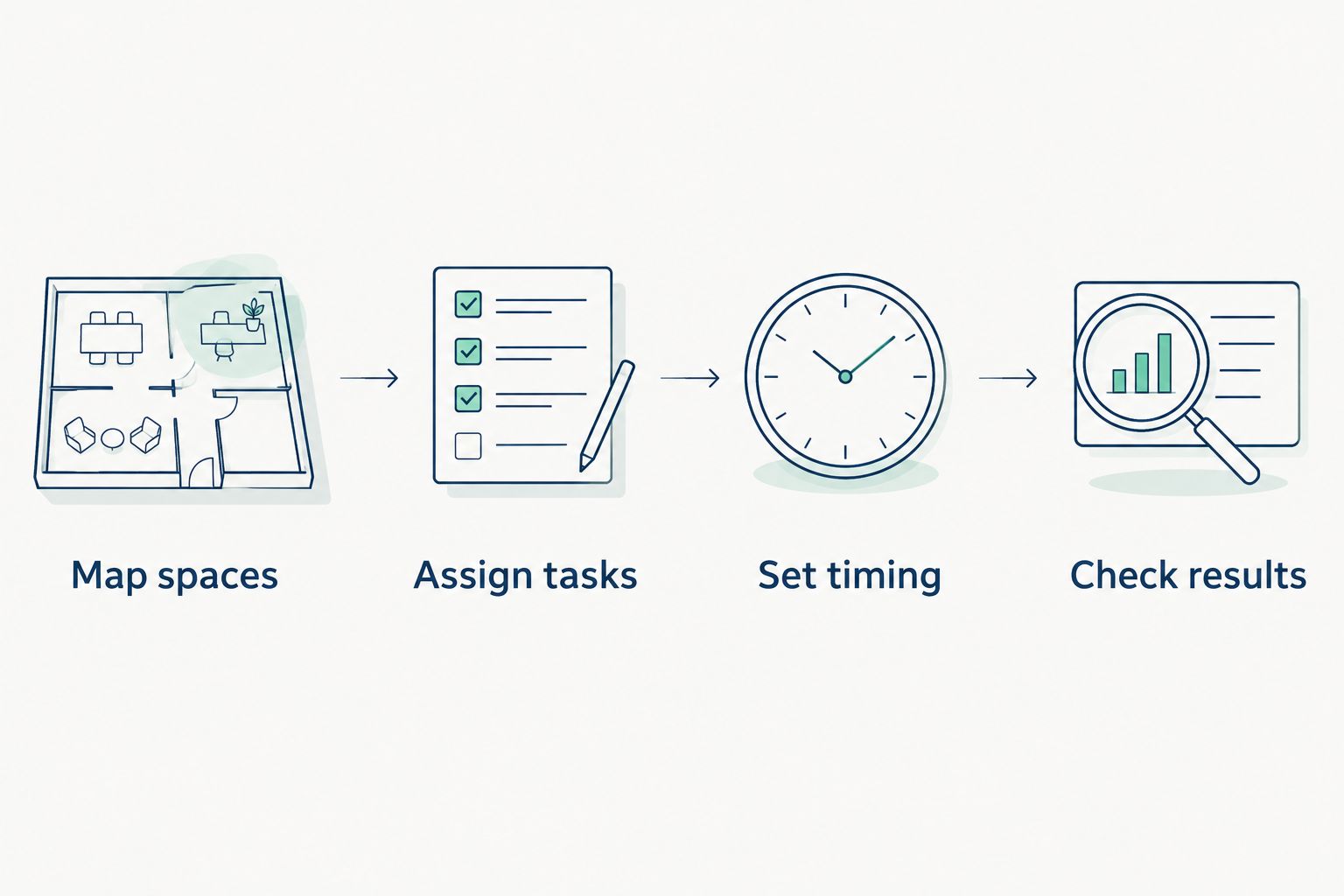
Write observable outcomes rather than broad adjectives. “Clean the conference room” leaves several interpretations; an instruction covering the table, accessible surfaces, floor, and waste containers gives both parties a clearer reference.
Keep exclusions visible. Desk papers, personal belongings, electronics, confidential waste, and locked rooms require explicit instructions rather than assumptions about what cleaners should touch.
How often should a Rockville office be cleaned?
Set frequency by area use and agreed tasks, not by a single building-wide label. A lightly used private office and a busy shared restroom do not need an identical task schedule.
Use your actual occupancy calendar. For example, an office occupied 5 days per week should identify which tasks follow each occupied day and which belong on a separate recurring schedule. That is a planning example, not a universal cleaning requirement.
Ask for 2 separate checklists: one for recurring visits and one for periodic work. This keeps a completed routine visit from being mistaken for completion of a carpet, floor, or glass-cleaning project.
Maintain 1 issue log for cleaning concerns. Record the location, task, report date, responsible contact, and resolution so that repeated problems remain visible during reviews.
Questions to ask before signing
Use the walkthrough to resolve operational questions, not just to show the premises. Ask each company to answer the same questions in its proposal:
- Who is your contact for routine requests and urgent issues?
- How are personnel instructed about alarms, keys, and restricted rooms?
- Who supplies equipment, cleaning products, and restroom consumables?
- What happens when the assigned cleaner is absent?
- How are completed tasks and corrective work checked?
- Which tasks require separate authorization?
- How are scope changes documented?
- What documentation supports the insurance and other credentials claimed?
For your 2026 selection, request a written response wherever the answer affects responsibility. A verbal assurance is difficult to compare and easy to remember differently.
Do not equate cleaning with disinfection. If disinfection is part of the requested work, identify the surfaces and require use according to the product label, including its directions and contact time.
How the options are ranked
The ranking prioritizes stated service fit, responsibility, schedule control, and the management work each arrangement leaves with you. It does not claim independently tested results or establish that one provider outperforms every Rockville competitor.
Outsourcing leads for an office seeking a commercial cleaning company. In-house staffing leads when direct supervision is the deciding requirement. Hybrid cleaning belongs third because it requires a clear boundary between internal and contracted duties.
Which office cleaning option should you choose?
Start with an outsourced provider when the goal is a service agreement rather than an internal staffing function. Consider RNM Building Services for its stated Montgomery County office-cleaning coverage, then evaluate the scope and accountability arrangements.
Choose in-house staffing when your organization wants direct supervision and accepts the associated management duties. Choose hybrid cleaning only when you can assign every task without relying on informal expectations.
The deciding document is the scope. Keep it specific enough that your manager and the cleaning team can independently identify what completion looks like.
FAQ
What's the best way to choose office cleaning in Rockville, MD?
Choose an office cleaning provider against a written scope covering tasks, timing, access, and accountability. Compare proposals for the same work rather than comparing general service descriptions.
Does RNM Building Services serve offices in Montgomery County?
RNM Building Services states that it provides commercial cleaning, janitorial, and building maintenance services for offices and managed properties throughout Montgomery County, Maryland. Confirm the proposed arrangements for your specific Rockville office before signing.
Is an office cleaning company better than an in-house cleaner?
An office cleaning company fits outsourced responsibility, while an in-house cleaner fits direct supervision. The better choice depends on who will manage staffing, supplies, training, and coverage.
How often should our office be cleaned?
Set your office cleaning schedule by occupancy, room use, and the tasks required in each area. Separate recurring janitorial duties from periodic projects instead of assigning every task the same frequency.
What should an office cleaning agreement include?
An office cleaning agreement should identify spaces, tasks, timing, exclusions, access rules, supplies, and issue-resolution responsibilities. It should also explain how changes and separately authorized work are documented.
Should office employees clean shared spaces between visits?
Employees can handle agreed housekeeping duties when those responsibilities are appropriate and clearly assigned. Keep trained cleaning work and tasks involving controlled procedures within the relevant service or staffing arrangements.
Does routine office cleaning include disinfection?
Do not assume routine office cleaning includes a separate disinfection service. Define the requested surfaces and procedures in the scope, and require any disinfectant to be used according to its label.
One last thing
Ask who owns the cleaning checklist when the agreement changes. A scope stored in a signed proposal but never updated can stop reflecting the work your office actually needs.
Keep one current scope accessible to both parties and record approved changes there. Inspect against that agreement, not informal expectations.
RNM Building Services