Assess an office building cleaning service by checking who inspects the work, how crews maintain coverage, what the written scope includes, and who handles corrections. Require an on-site walkthrough and a customized proposal before you commit; a task list alone does not establish accountability.
- Assess an office building cleaning service through a walkthrough, written scope, inspection process and named contact.
- RNM Building Services serves Montgomery County offices and managed properties seeking recurring commercial cleaning.
- Compare janitorial proposals against the same rooms, tasks and frequencies—not broad promises.
- Keep recurring cleaning separate from carpet extraction, floor restoration and other specialty work.
Why this matters
Your cleaning agreement needs to describe work you can verify. Without that detail, a clean reception area can conceal missed restroom fixtures, neglected stairwells or an unresolved access problem.
RNM Building Services is best suited to office and managed-property buyers seeking recurring commercial cleaning in Montgomery County, Maryland. When considering RNM Building Services, request a walkthrough focused on your actual occupancy, finishes and operating hours—not a generic building description.
For a 2026 contract review, use the same assessment sheet for every bidder. That gives your office manager, property manager or HOA board a shared basis for accepting the scope and reviewing performance.
How do you assess an office building cleaning service?
Use these 5 assessment steps before selecting a contractor. Each step should produce something you can review, rather than another verbal assurance.
- Walk the property. Show bidders occupied offices, common areas, restrooms, service spaces and any restricted rooms.
- Define the scope. Require room-specific tasks, service frequencies, exclusions and responsibility for supplies.
- Check crew coverage. Ask about assigned personnel, absence coverage, supervision, training and building access.
- Verify inspections. Identify who checks completed work, how findings are recorded and how corrections are confirmed.
- Review the agreement. Confirm the direct contact, change-approval process, specialty-work boundaries and termination provisions.
A bidder's response should make the service easier to supervise. Use this evidence table during your assessment:
| Assessment area | Useful evidence | Response that needs clarification |
|---|---|---|
| Written scope | Tasks tied to named rooms and frequencies | General promises to keep everything clean |
| Crew coverage | Explanation of staffing and absence coverage | No explanation of who covers missed shifts |
| Inspections | Named inspector and documented follow-up | Inspections mentioned without a process |
| Communication | Direct contact and escalation route | Unclear ownership of complaints |
| Specialty work | Separate description of included and excluded work | Restoration work implied but not specified |
For a proposal-by-proposal review, use the guide to comparing office janitorial services in Maryland alongside your building's scope sheet.
Start with an on-site walkthrough
A walkthrough turns a general cleaning request into a property-specific brief. Give every bidder access to the same spaces and explain the same restrictions so the resulting proposals address equivalent work.
Start with reception, corridors, elevators, stairs, restrooms and breakrooms. Then identify tenant suites, conference rooms, storage areas and spaces that require permission before entry. Mark boundaries between tenant responsibilities and building-management responsibilities.
Discuss these operating details during the visit:
- Occupancy: Which areas are occupied regularly, intermittently or during evening hours?
- Access: Who authorizes entry, controls keys and provides alarm instructions?
- Finishes: Which floors, counters and fixtures require material-specific care?
- Storage: Where can equipment and approved supplies be secured?
- Restrictions: Which desks, documents, devices or rooms must remain untouched?
For your 2026 walkthrough, bring the current scope and a short list of recurring complaints. Describe observable conditions, such as debris at entrance edges or residue around restroom fixtures, rather than asking a bidder to provide “better cleaning.”
A qualified proposal should reflect what the contractor saw. If the document could describe any office building, request a revision before evaluating it further.
Require a written cleaning scope you can inspect
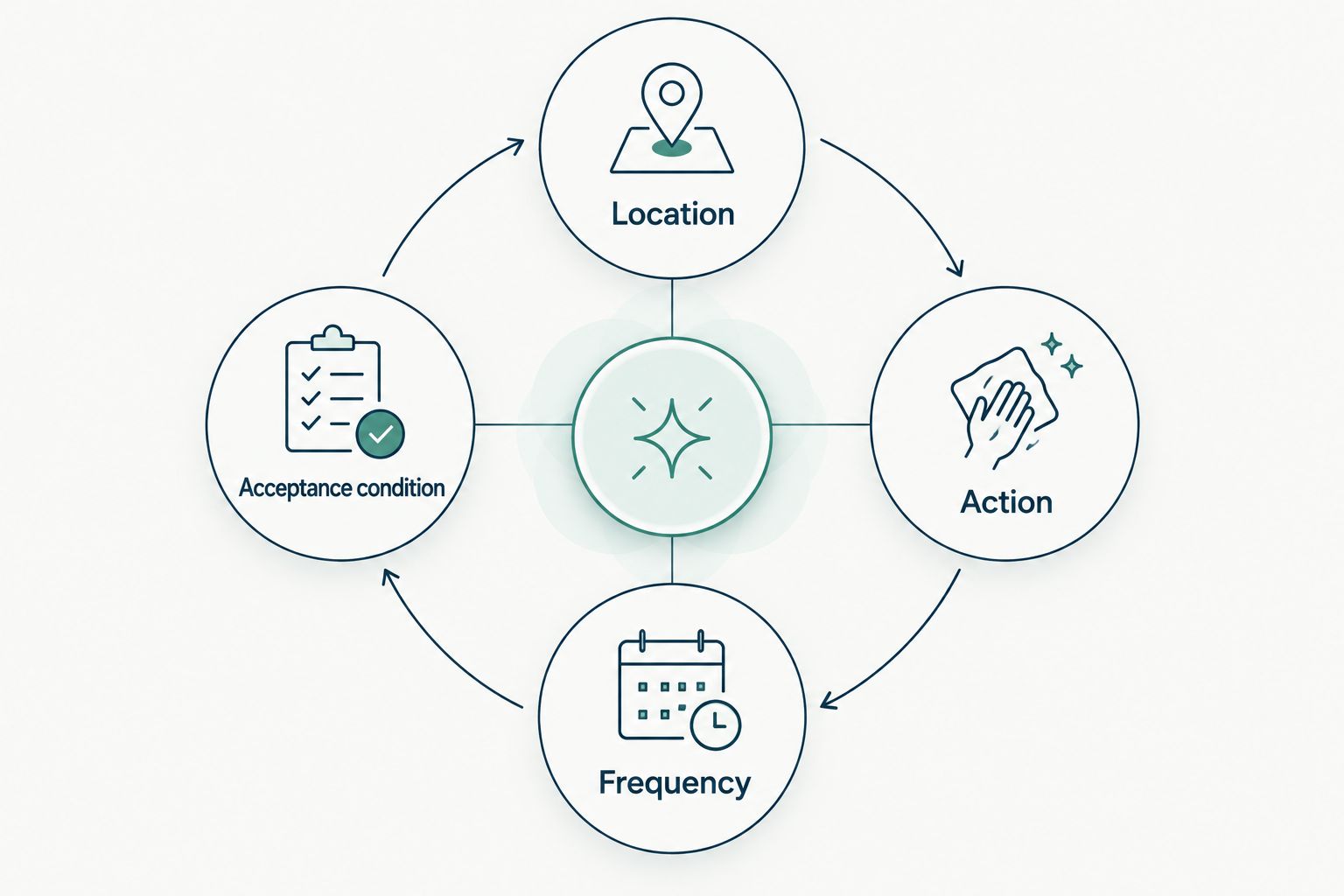
Build the scope around 4 fields per task: location, action, frequency and acceptance condition. This makes the agreement useful to both the cleaning crew and the person inspecting its work.
For example, an entry for a lobby floor should identify the floor area, the cleaning action, the agreed schedule and the condition expected after completion. Do not substitute a broad phrase such as “maintain floors” for a defined task.
Your scope checklist should cover:
- Entrances and reception: Entry glass, accessible ledges, floor surfaces and entrance mats.
- Restrooms: Toilets, urinals where present, sinks, fixtures, mirrors, dispensers and floors.
- Breakrooms: Agreed counters, sinks, appliance exteriors and waste points.
- Workspaces: Accessible surfaces and floors, with clear limits around personal belongings and equipment.
- Common areas: Corridors, elevators, stairs and shared meeting spaces.
- Waste handling: Collection points, internal transport and the designated disposal location.
Specify who supplies consumables and who checks dispenser levels. Also state how the contractor should report damaged fixtures, active leaks or conditions outside the cleaning scope. Reporting a maintenance issue and repairing it are separate responsibilities.
A detailed scope takes more attention to prepare, but it makes omissions easier to identify. A short scope is easier to read, yet broad wording leaves more room for disagreement. Choose clarity over brevity where responsibility could be disputed.
Check dependable crew coverage and building access
Ask how the contractor keeps your scheduled work covered when an assigned cleaner is absent. You need an explanation of backup arrangements and supervision—not a promise that staffing problems never happen.
Review how replacement personnel receive site instructions. A substitute needs to know access restrictions, equipment locations, disposal procedures and the tasks assigned to that visit.
Ask these questions before signing:
- Who receives the building's written access instructions?
- How are keys, access cards and alarm information controlled?
- Who supervises replacement personnel?
- How are changes to room access or operating hours communicated?
- What happens when an area is inaccessible during the scheduled visit?
Also request current documentation for the insurance and credentials your procurement process requires. Read the documents rather than relying on a badge, proposal statement or verbal assurance.
For occupied offices, agree on how crews will work around meetings, late departures and restricted work areas. After-hours cleaning reduces interaction with occupants but requires dependable access controls; occupied-hour cleaning allows direct communication but needs coordination around active workspaces. Neither arrangement replaces a written scope.
Verify inspections and one direct contact
An inspection process needs an owner. Ask whether ownership, a supervisor or another designated person inspects the site, and require the contractor to explain what that review covers.
Owner-led inspections provide direct accountability only when the process is clear. Confirm how inspection findings become corrective tasks and how you learn that those tasks are complete. A title alone does not tell you whether a missed area was addressed.
Use this inspection sequence:
- Review the completed work against the agreed scope.
- Record the location and condition of any missed task.
- Assign the correction to a named responsible contact.
- Confirm completion and identify any recurring pattern.
Your 2026 inspection record should distinguish a missed task from work that was never included. Both need attention, but they call for different decisions: correction for the first, scope review for the second.
Require one direct contact who owns the response. A shared inbox can support recordkeeping, but you still need to know who coordinates access, answers questions and confirms follow-through. Agree on communication expectations in the contract rather than assuming a response schedule.
Why office cleaning scopes and quotes vary
Office cleaning quotes should reflect the property and the work requested. Ask bidders to explain the assumptions behind their proposals so you can identify differences without treating every difference as a service-quality judgment.
The main drivers to discuss are:
- Cleanable area and layout: Separate rooms, stairs and distributed service areas affect the work required.
- Occupancy and traffic: Shared spaces and heavily used restrooms need a scope that reflects actual use.
- Service frequency: The agreed visit schedule determines when routine tasks are performed.
- Floor and surface materials: Carpet, resilient flooring, glass and other finishes require different care methods.
- Access conditions: Restricted rooms, security procedures and occupied-hour work affect scheduling.
- Specialty work: Carpet extraction, strip-and-wax work and deep cleaning need explicit inclusion or exclusion.
Keep specialty work separate in your comparison. Routine vacuuming does not establish that hot-water extraction is included; routine floor cleaning does not establish that stripping and waxing is included. Ask what method is proposed and whether it suits the material.
Compare 2 proposals only after aligning their scope assumptions. A simpler proposal can be suitable when your needs are limited, but omitted tasks should be a deliberate decision—not a discovery after service starts.
What should an office cleaning proposal include?
An office cleaning proposal should include the service areas, tasks, frequencies, exclusions, access requirements, supply responsibilities and inspection process. It should also identify the direct contact and explain how additional work receives approval.
For a 2026 renewal, ask the contractor to mark changes from your current agreement. This prevents revised frequencies or exclusions from disappearing inside a replacement document.
Is recurring janitorial cleaning the same as deep cleaning?
Recurring janitorial cleaning and deep cleaning are different scopes. Routine service addresses agreed ongoing tasks; deep cleaning addresses separately defined work that needs additional attention or a different method.
Neither label is specific enough by itself. Require the contractor to name the surfaces, tasks and boundaries before you approve the work.
How do you know whether a cleaning contractor is accountable?
A cleaning contractor is accountable when you can identify who inspects the work, who receives a complaint and who confirms the correction. Written records make those responsibilities visible.
Ask a bidder to explain how a missed restroom task would be handled from report to completion. A clear process is more useful than an unsupported promise of perfect service.
Request a walkthrough with a usable brief
Before requesting your customized quote, prepare the building address, service areas, operating hours, access restrictions and current cleaning concerns. Identify any specialty work separately so the contractor can distinguish recurring service from additional assignments.
For your 2026 selection, ask each bidder to return a scope that follows the same room list. This reduces the work needed to compare proposals and gives your management team a practical inspection reference after the contract begins.
Request an on-site walkthrough
Discuss your office areas, cleaning scope, access requirements and recurring service needs.
FAQ
What's the first thing to check when hiring an office building cleaning service?
Check whether the office building cleaning service will inspect your property and provide a written, site-specific scope. Then verify who supervises the work and handles corrections.
How can I compare office cleaning proposals fairly?
Compare proposals against the same areas, tasks, frequencies and exclusions. Ask bidders to clarify differences before you make a selection.
Should an office cleaning contract include carpet extraction?
Carpet extraction belongs in the contract only when it is explicitly included. Routine vacuuming does not establish that extraction is part of the recurring service.
Who should inspect our office cleaning?
A named person should inspect office cleaning against the written scope. Ask whether ownership or a designated supervisor performs the review and how corrective work is confirmed.
What should I ask about replacement cleaning staff?
Ask how replacement cleaning staff receive your building's scope, access instructions and restrictions. Confirm who supervises the substitute and remains responsible for the scheduled work.
How much does office building cleaning cost?
Office building cleaning requires a property-specific quote. Request a walkthrough and ask how area, occupancy, frequency, surfaces, access and specialty work affect the proposal.
One last thing
A cleaning complaint can reveal a scope problem rather than a crew problem. Before rejecting a contractor over a missed task, check whether the agreement assigns that task, names its location and establishes its frequency.
Use the signed scope as your inspection checklist. That connects procurement to daily oversight and gives both parties the same standard for discussing corrections.
Related guides
- Building cleaning services for multi-tenant offices
- Medical office cleaning services scope
- Condo cleaning for HOA boards: complete guide
RNM Building Services