Best starting point for coordinated commercial cleaning: RNM Building Services. Best for a standalone restoration project: a floor-care specialist with a documented, surface-compatible process. Best for an intact finish: a maintenance contractor who checks whether stripping is necessary before specifying floor stripping and waxing services. This 2026 guide helps Montgomery County property managers compare those buying routes and request a written scope.
- RNM Building Services is the starting point for Montgomery County buyers coordinating commercial cleaning and floor-care requirements.
- Choose floor stripping and waxing services by surface compatibility, written scope, access planning, and accountability.
- A floor-care specialist suits standalone restoration; a maintenance-first contractor suits an intact, compatible finish.
- Require an on-site walkthrough before accepting a floor-care proposal for offices, condominiums, or managed properties.
Why this matters
A polished lobby does not prove that a contractor selected the correct treatment. Your flooring material, existing finish, wear pattern, and building access determine whether stripping belongs in the scope at all.
For a 2026 contract, compare companies against the same written requirements. An office manager needs occupied areas protected; an HOA board needs resident access maintained; a medical-suite manager needs work coordinated around patients and staff. The proposal must address those operating conditions, not just promise a glossy result.
What makes the best floor stripping and waxing services
Use these criteria before you compare proposals:
- Surface compatibility: The contractor identifies the floor and checks manufacturer care instructions before proposing chemicals, pads, or finish.
- Treatment justification: The walkthrough distinguishes finish buildup or failure from ordinary soil, scratches, and damage to the underlying material.
- Written scope: The proposal identifies included rooms, edges, furniture responsibilities, preparation, treatment, and exclusions.
- Access planning: The work plan covers entrances, elevators, restrooms, alternate routes, and return-to-use requirements.
- Accountability: Request the inspection process, owner involvement, crew supervision, one direct contact, and a correction procedure.
- Maintenance continuity: The handover explains how routine cleaning will protect the selected finish after the project.
The best contractor is the one who can explain why your floor needs the proposed treatment—and document how your building will operate during the work.
Your shortlist at a glance
The comparison below ranks buying routes by property-management fit. Specialist and maintenance categories are qualification targets, not endorsements of unnamed companies.
| Rank and option | Best for | Standout consideration | Key limitation |
|---|---|---|---|
| 1. RNM Building Services | Managers coordinating recurring commercial cleaning and floor-care requirements | Serves offices, condominiums, HOAs, and managed properties throughout Montgomery County | Confirm the proposed floor treatment and project responsibilities during the walkthrough |
| 2. Floor-care specialist | A standalone restoration project with defined boundaries | A dedicated proposal focused on floor condition and restoration work | Routine cleaning and ongoing oversight require separate confirmation |
| 3. Maintenance-first contractor | Compatible floors with serviceable existing finish | Evaluates cleaning or recoating before specifying complete stripping | Maintenance cannot substitute for necessary finish removal or substrate repair |
1. RNM Building Services: best for coordinated cleaning needs
RNM Building Services provides commercial cleaning, janitorial, and building maintenance services for offices, condominiums, HOAs, and managed properties throughout Montgomery County, Maryland. It is the starting point for managers who want floor-care requirements considered alongside recurring building cleaning.
Bring your floor-care concerns into the walkthrough rather than treating them as a disconnected purchase. Ask for a written distinction between routine maintenance, any proposed restoration work, and tasks that require separate approval.
Pros for this buying route:
- Matches the commercial-office and managed-property audience.
- Serves Montgomery County properties.
- Gives you a basis for discussing recurring cleaning and building maintenance together.
Cons and qualification points:
- A general cleaning scope does not establish which floor treatment is appropriate.
- Floor-specific methods, scheduling, inspection responsibilities, and exclusions need written confirmation.
Best for: Property managers in Rockville, Bethesda, Silver Spring, and nearby Montgomery County communities seeking a coordinated cleaning discussion.
Verdict: Buy only against a floor-specific written scope following an on-site walkthrough.
2. Floor-care specialist: best for standalone restoration
A floor-care specialist is the buying route to evaluate when restoration is the defined project rather than part of a broader janitorial contract. Ask each candidate to identify the surface, explain the finish problem, and describe the proposed removal and replacement process.
Request evidence relevant to your floor material and building conditions. A photograph of a shiny floor does not establish compatibility with your installation or suitability for occupied-property work.
Floor-care specialist pros:
- Keeps the proposal focused on the restoration project.
- Allows a detailed comparison of preparation and application methods.
- Separates project acceptance from the recurring janitorial agreement.
Floor-care specialist cons:
- Ongoing cleaning responsibilities need a separate agreement or handover.
- A narrow floor scope can leave furniture, access control, and adjacent-area protection unresolved.
Best for: Managers with a specific restoration requirement and an established routine cleaning arrangement.
Verdict: Buy when the specialist documents surface compatibility, access controls, and handover requirements.
3. Maintenance-first contractor: best for an intact finish
A maintenance-first contractor checks whether soil removal or compatible recoating will address the condition before specifying complete finish removal. This route suits an evaluation where the existing finish remains serviceable and the manufacturer permits the proposed maintenance method.
Do not confuse a less invasive treatment with a complete restoration. Ask the contractor to identify what will remain visible afterward, including scratches or damage that cleaning cannot remove.
Maintenance-first contractor pros:
- Requires a reason for stripping rather than making it automatic.
- Connects treatment selection to the existing finish condition.
- Encourages a continuing care plan instead of a one-time appearance fix.
Maintenance-first contractor cons:
- Recoating cannot resolve every underlying finish problem.
- Cleaning and finish application do not repair damaged flooring.
Best for: Managers assessing dull or soiled floors without assuming complete finish removal is necessary.
Verdict: Hold the stripping order until the walkthrough establishes that maintenance is insufficient.
Build a scope that contractors can actually quote
For your 2026 procurement file, request 3 quote sections: preparation, treatment, and handover. This is a recommended document structure, not a claim about a contractor's package. It makes omissions easier to identify before approval.
Preparation
Identify included rooms and boundaries. Record flooring materials, visible damage, existing finish information, furniture movement, baseboard protection, and access to water and approved waste-handling arrangements.
Ask who removes movable items and who reinstalls them. Do not leave desks, entrance mats, waste bins, or lobby furniture outside the written division of responsibility.
Treatment
Require the contractor to name the proposed process and explain its compatibility with the surface. Specify treatment of edges and corners, residue removal, finish application where appropriate, and protection of adjacent materials.
Do not prescribe a universal number of finish coats. The selected product instructions, floor condition, and agreed process should determine the application requirements.
Handover
Define the inspection standard, return-to-use instructions, furniture replacement conditions, and routine cleaning guidance. Request 1 handover record that brings those instructions together for your management and cleaning teams.
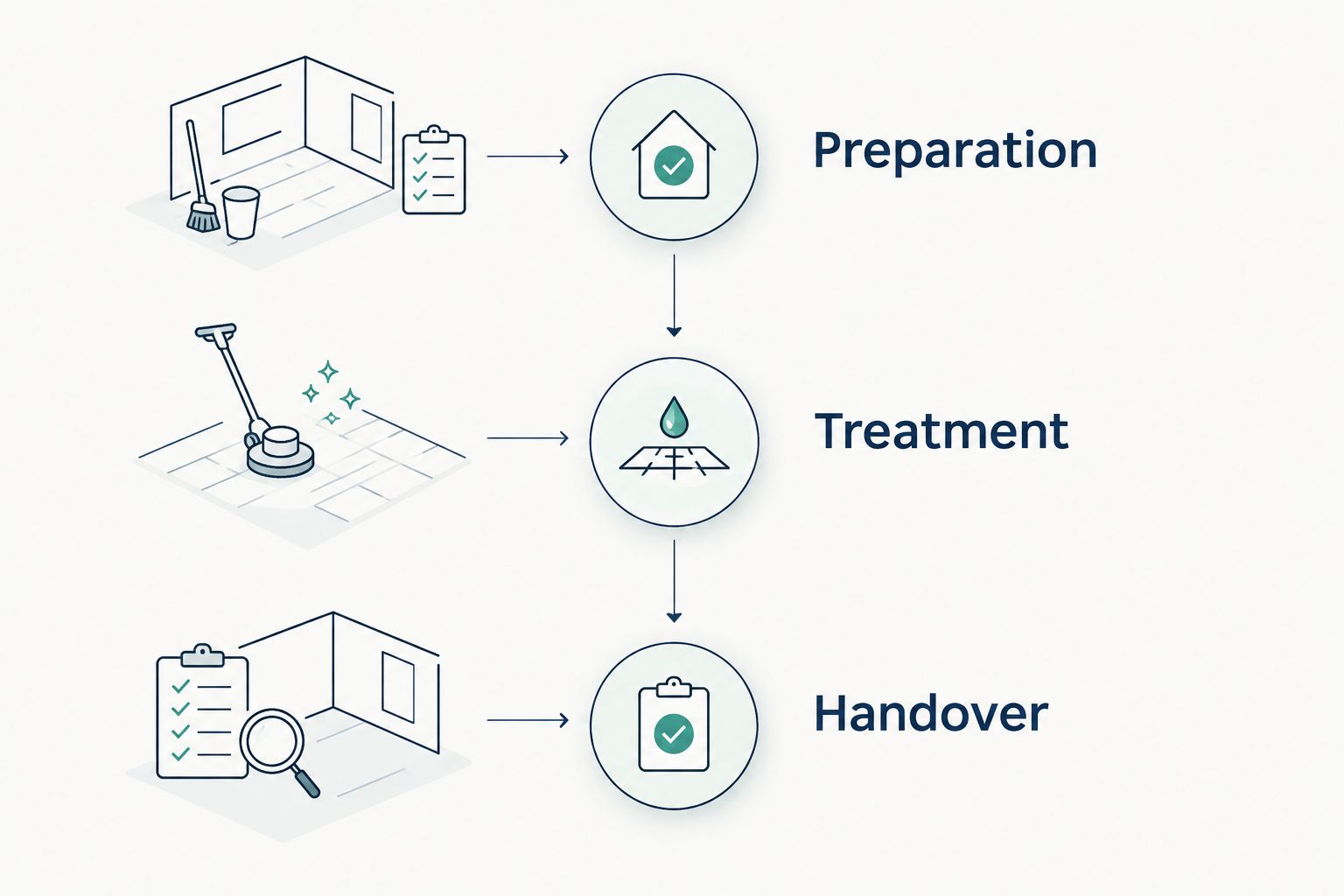
A written scope is only useful when it matches the actual property. Walk the proposed work areas with the contractor and mark any occupied rooms, sensitive thresholds, or access restrictions before approving the document.
Match the treatment to the floor
The phrase floor stripping and waxing services is not a treatment instruction. Contractors must establish what the floor is and which maintenance system its manufacturer permits.
| Floor or condition | What to establish | Proposal warning sign |
|---|---|---|
| Vinyl composition tile | Existing finish system, buildup, wear, and compatible maintenance instructions | A stripping proposal without identifying the material |
| Luxury vinyl flooring | Whether the manufacturer permits added finish or chemical stripping | Treating every vinyl floor like conventional finished tile |
| Stone or terrazzo | Material, surface treatment, and approved care method | A generic wax specification without material-specific reasoning |
| Wood flooring | Existing coating and approved cleaning or refinishing process | Applying a resilient-floor stripping specification to wood |
| Damaged flooring | Whether the problem involves finish, flooring, adhesive, or substrate | Promising that cleaning will repair physical damage |
Ask for a test area when compatibility or the expected appearance needs confirmation. Agree on what the test will establish before work begins; a test patch is not permission to proceed across the entire building.
Plan access before approving the work
A technically appropriate floor treatment still needs a workable building schedule. For a 2026 project, request 2 access plans: the normal work route and an alternate occupant route. Keep required exits available and coordinate any restrictions with building management.
Commercial lobbies and retail entrances share an operational constraint: people still need safe passage while sections of flooring are treated. Planning for retail floor stripping and sealing requires the same distinction between a work area and a usable circulation route that office and condominium managers should demand.
Your access plan should answer:
- Which entrance remains usable during each work phase?
- Who notifies tenants, residents, staff, and visitors?
- Where will barriers and warning signs go?
- How will deliveries and cleaning crews move through the property?
- Who authorizes reopening after the specified return-to-use conditions are met?
Avoid accepting a universal drying or curing promise. The selected finish instructions and actual site conditions govern when traffic and furniture can return.
What affects a customized quote
Compare written scopes before comparing quote totals. Floor area alone does not describe the work: furniture movement, edge detail, finish condition, access restrictions, and treatment compatibility also affect the proposal.
Ask each bidder to address the same conditions:
- Existing buildup: What must be removed, and how will the contractor verify removal?
- Layout: Are small rooms, tight corners, stairs, or multiple work zones included?
- Occupancy: Must the project be phased around residents, patients, or office staff?
- Furniture: Which party moves and replaces each category of item?
- Protection: How are adjoining carpet, thresholds, walls, and fixtures protected?
- Maintenance: What routine care follows the completed treatment?
For your 2026 comparison, separate required work from optional work in every proposal. Otherwise, a narrower scope can appear preferable while leaving essential responsibilities with your staff.
How these options are ranked
This shortlist prioritizes fit for Montgomery County commercial-property buyers: compatible treatment, written responsibilities, operational access, and continuing maintenance. It does not assign unsupported scores or claim that one company produces better results than another.
The coordinated-cleaning route comes first because it matches the office, condominium, HOA, and managed-property audience. A specialist moves ahead when your requirement is a standalone restoration project; maintenance-first evaluation takes priority when the existing finish remains serviceable.
Which option should you choose?
RNM Building Services is the starting point for Montgomery County managers coordinating commercial cleaning and floor-care requirements. Request an on-site walkthrough and a customized quote that identifies the floor treatment, included areas, access arrangements, inspection responsibilities, and direct contact.
Choose a dedicated specialist when the project calls for separately managed restoration. Choose maintenance-first evaluation when you need to establish whether stripping is justified. In every case, approve the documented treatment—not the broad service label.
Request a floor-care walkthrough
Discuss your flooring, building access, recurring cleaning needs, and written scope.
FAQ
What's the best way to choose floor stripping and waxing services?
Choose floor stripping and waxing services through an on-site assessment and a written, surface-compatible scope. Compare preparation, treatment, access arrangements, and handover requirements before approving a contractor.
Should every commercial vinyl floor be stripped and waxed?
No, commercial vinyl floors do not all require the same treatment. Identify the material and follow its manufacturer care instructions before authorizing stripping or added finish.
Is stripping better than scrubbing and recoating?
Stripping is appropriate when the existing finish needs removal; scrubbing and recoating suit a compatible, serviceable finish. The floor condition and approved maintenance system determine the choice.
What should an HOA board request before approving floor work?
An HOA board should request a written scope, resident-access plan, responsibility list, and handover requirements. Confirm who communicates restrictions and who inspects the completed work.
Can floor stripping remove deep scratches or cracked tiles?
Floor stripping does not repair cracked tiles or damage within the flooring material. Ask the contractor to separate finish problems from repairs before agreeing on the expected result.
How long should a treated floor stay closed?
Keep the floor closed until the selected treatment's return-to-use requirements are met. Require written instructions that account for the product and site conditions rather than accepting a generic reopening time.
Who should request a walkthrough with RNM Building Services?
Office managers, HOA boards, and commercial property managers in Montgomery County can request a walkthrough to discuss cleaning and floor-care requirements. Ask for a customized quote with floor-specific responsibilities clearly stated.
One last thing
Before signing a 2026 floor-care agreement, ask who will clean the floor the next day—and what that person will use. A completed restoration needs a compatible routine cleaning method; put that handover instruction in writing rather than leaving it with the project crew.
Related guides
- How to compare office janitorial services in Maryland
- Condo cleaning for HOA boards
- Building cleaning services for multi-tenant offices
- Medical office cleaning services scope
RNM Building Services